
A deal memo template brings the main engagement details together: parties, role, dates, compensation basis and referenced terms. Describe the actual arrangement and identify unresolved decisions. Its short format does not determine whether the wording creates obligations; review it for the intended use.
Describe deliverables in a statement of work, maintain approved contact routes in a contact information record and organize assignments in a task list. Connect supporting records to the same engagement without using a task list to silently change agreed terms.
The five previews below have three original external destinations and two unlinked download graphics. They include crew, cast, and general examples. Inspect the selected resource’s actual file, terms, access conditions, and production context rather than assuming five ready-to-sign forms.
The general agreement guide discusses broader contract structure, an expense report records expenditure for review, and a work plan organizes delivery activity. A deal memo should record the real engagement while keeping expense claims and task planning distinguishable.
What Is a Deal Memo?
A deal memo is a written summary of the principal terms agreed between two or more parties. In film production, it can be used when hiring a crew member, actor, performer, director, or other production professional.
A film deal memo can document the person’s role, project information, agreed compensation, work period, services, credit, and other important terms. It gives the parties a written understanding of the deal before a longer-form agreement is completed, where one is required.
Film and Production Deal Memo Template
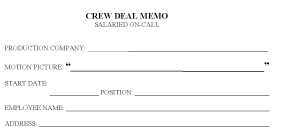
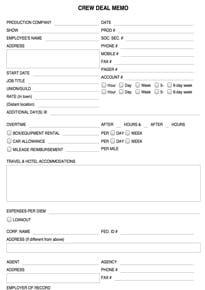
A film deal memo template is particularly useful for independent producers, production companies, filmmakers, and entertainment professionals who need to document agreements efficiently. A crew deal memo may contain information about the crew member’s position, production dates, rate, working conditions, and other employment or engagement terms.
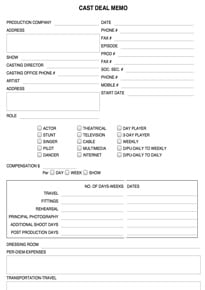
A cast deal memo can similarly record the basic agreement between a production and an actor or performer. The exact terms depend on the project, role, applicable agreements, and negotiated arrangement.
Crew Deal Memo Template
A crew deal memo template provides a structured format for documenting an agreement with a production crew member. It can be adapted for cinematographers, production assistants, editors, sound professionals, makeup artists, camera operators, and other film-production roles.
The template should be completed carefully so that compensation, dates, responsibilities, and other important terms accurately reflect what the parties have agreed.
Cast Deal Memo Template
A cast deal memo is used to summarize the principal terms of an actor’s or performer’s engagement. Depending on the production, it may cover the role, compensation, production dates, services, credit, publicity obligations, and other agreed conditions.
A cast deal memo should not be treated as a substitute for a required long-form contract, union agreement, or other legally binding documentation.
Editable and Printable Deal Memo
An editable deal memo template makes it easier to customize a document for a specific production and professional relationship. You can enter the project name, parties, role, dates, compensation, and negotiated terms.
A printable deal memo template can be signed physically, while an electronic version may be appropriate where electronic signatures are accepted. Always ensure that the final document accurately reflects the agreement before signing.
The five examples on this page include a Simple Crew Deal Memo, Deal Memo Sample, Example of Cast Deal Memo, Deal Memo Printable, and Deal Memo Free Template, providing several formats for different production situations.
How to Use a Deal Memo Template
Start by identifying the parties and the project. Clearly enter the person’s role or services, agreed dates, compensation, and other important terms. Review the entire document carefully and make sure there are no unclear or contradictory provisions.
A deal memo is most useful when both parties have the same understanding of the arrangement. For significant productions or agreements involving substantial compensation or rights, consider having the document reviewed by an appropriately qualified legal professional.
Identify the production and engagement accurately
Name the actual project and contracting parties. A working production title and a legal entity name serve different purposes, so make their relationship clear where needed. A generic studio label should not replace the entity actually entering the arrangement.
Describe the person’s role and the scope of services. A cinematographer, performer, editor, and production assistant have different work contexts. Copying every provision from another role’s memo can create obligations that do not fit the engagement.
Specify whether the document is a proposal, a summary for review, or the agreement the parties intend to use. A draft should not appear fully executed. The document’s actual effect still needs review; a casual title alone does not decide whether obligations arise.
Make compensation units understandable
Record the actual compensation basis and the relevant conditions. A rate per day, per week, per hour, or for a defined deliverable describes different arrangements. Avoid a bare amount that leaves the unit and scope unclear.
If additional items are relevant, identify their treatment through the applicable agreement and requirements. Expenses, equipment, travel, additional work, and other provisions should not be assumed included merely because the memo has one rate field.
This guide does not set minimum rates, overtime rules, employment classification, or tax treatment. Those questions depend on the actual engagement and applicable law or agreements. A template’s example rate is not evidence of a permissible arrangement.
Keep dates and availability distinct
Identify the work dates or period and any actual scheduling arrangement. A tentative date differs from a confirmed call or agreed working period. A person’s indicated availability does not by itself establish that the production has hired them for that period.
Where the engagement includes different phases, identify the relevant scope. Preparation, production, and post-production can have different timing and deliverables. A single date line may be insufficient when the actual arrangement spans several distinct activities.
Changes need the real approval and communication process. Do not replace an earlier agreed date silently in one copy while another person continues using the old schedule. Keep the current terms and relevant amendment reference distinguishable.
Fictional example: a defined editing deliverable
Imagine an invented production engaging an editor for a specified draft cut and one agreed review round. The memo identifies the actual contracting parties, project, deliverable, target date, and compensation basis. It does not assume every later edit is included.
The project subsequently proposes another review round. The parties use their actual change process to clarify scope, timing, and compensation. The original memo is not treated as blanket permission for unlimited additional work simply because it names an editor.
A separate expense process records any agreed reimbursable expenditure and evidence. The existence of an expense field does not make every purchase eligible. Engagement terms and a submitted expense report answer different questions.
This example illustrates scope boundaries and record connections. It does not establish contract language, industry rates, or a classification decision. A real production needs its actual terms and appropriate review before relying on a document.
Check applicable industry agreements
SAG-AFTRA's contracts and industry resources provide agreement information for relevant performer engagements. Use the actual agreement and appropriate production process where it applies. A generic cast memo cannot replace a required union agreement or establish its terms.
Different crew, performer, and production contexts may have different applicable requirements. Do not assume a sample labeled film covers every medium, location, or role. The engagement’s actual circumstances matter more than the resource’s broad title.
Review required forms, references, and approvals through the relevant qualified process. This article does not summarize every industry obligation. It helps organize the questions and record accurate terms without inventing a complete legal framework.
Treat rights and credit as substantive terms
Credit wording should reflect the real agreement and relevant requirements. A line naming a proposed credit does not establish every placement, size, or approval condition. Identify the actual term rather than assuming the parties share the same meaning.
Intellectual-property, performance, publicity, and reuse questions can carry significant consequences. A generic clause should not be copied merely to make the memo look professional. Obtain appropriate review of the actual rights and intended use.
Do not treat an engagement’s short length as a reason to omit an important term or assume unlimited permission. A concise memo can still refer to the applicable detailed agreement. The reference should identify the correct document and version.
Resolve inconsistencies before execution
Compare the memo with the relevant offer, schedule, and referenced agreement. A difference in rate, dates, services, or party name should be addressed rather than left for readers to reconcile themselves. The signed version needs to reflect the actual agreed arrangement.
Identify any open issue honestly. A blank or provisional field can show that a decision remains, while an invented entry creates a misleading appearance of agreement. Do not fill an approval or signature line with sample content.
Where the document is changed, make the updated version clear and use the actual execution process. A new file name without communication may not prevent conflicting copies. Keep the relevant correspondence and references connected to the final record.
Inspect resources and maintain a clear master
The external pages may offer forms, examples, or services rather than direct files of the same format. Inspect the actual resource and its access conditions. A preview caption does not establish current availability or unrestricted use.
Review the selected document’s clauses as well as its layout. A neat template can contain role-specific or jurisdiction-specific provisions that need adjustment. Formatting work should follow appropriate review of the actual content.
Clear actual names, rates, dates, signatures, and project details before preparing a reusable blank master. Keep executed records separate from demonstration copies. A useful deal memo supports a precise engagement record while the real arrangement and applicable requirements determine its effect.
Simple Crew Deal Memo

Deal Memo Sample
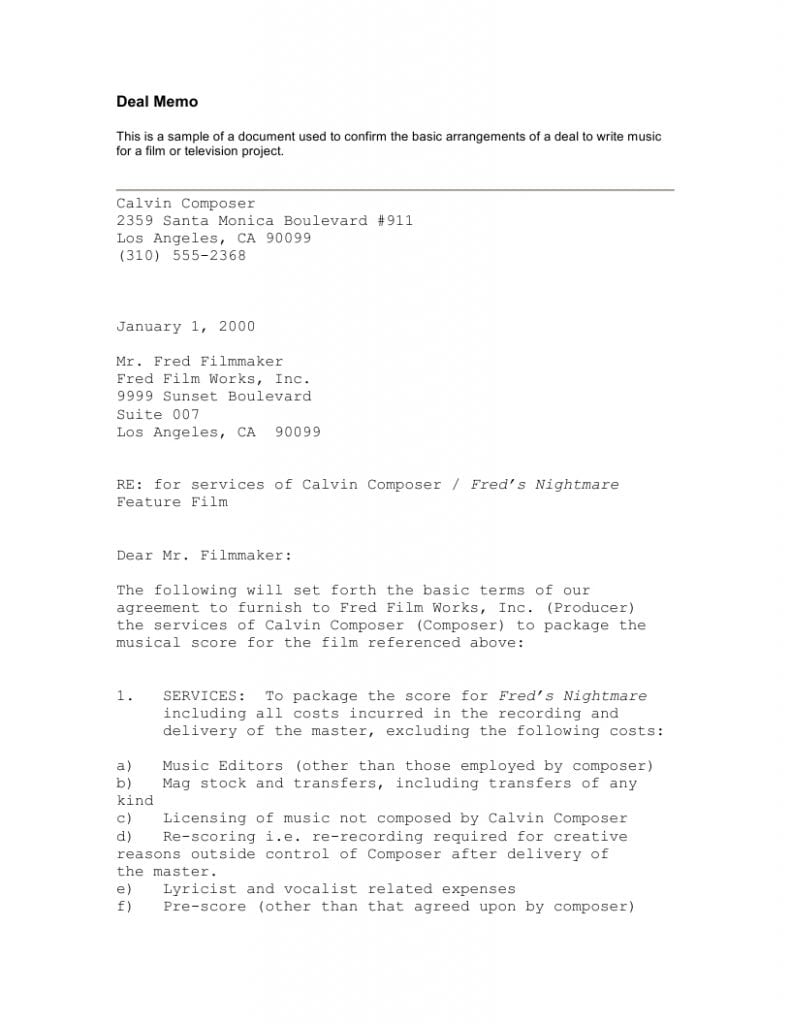
Example Of Cast Deal Memo

Deal Memo Printable

Deal Memo Free Template
Frequently Asked Questions
Is a deal memo always nonbinding?
No. Its effect depends on the actual wording, arrangement, and applicable requirements. A short document or casual title does not decide that issue.
Are all five previews linked to direct files?
No. Three original destinations are external pages and two graphics are unlinked. Inspect the selected resource’s actual offering.
Can a crew memo be used for any performer engagement?
Do not assume so. Roles and applicable agreements differ, and a generic memo cannot replace a required agreement.
What compensation information matters?
Identify the actual rate or amount, unit, scope, and relevant conditions. A bare number can leave the arrangement unclear.
Does a target date establish confirmed employment?
Not by itself. Record the actual engagement status and distinguish tentative dates from agreed commitments.
Should rights clauses be copied from a sample?
Review them for the actual engagement through an appropriate qualified process. A sample does not establish suitable rights terms.
How should additional work be handled?
Use the real change process to clarify scope, timing, and compensation. Do not assume a named role means unlimited work.
What should be removed from the master?
Clear actual parties, project details, rates, dates, signatures, and completed decisions while retaining the appropriate reviewed structure.

