
Credit card authorization form templates help describe permission for a specified charge or payment arrangement. Identify its amount basis, timing and limits, and connect it to the payment provider’s approved process. An office worksheet should document the permission without becoming a store for authentication credentials.
Link the agreed charge to a quotation, identify the billed service using a service invoice and use a sales receipt for a confirmed retail payment. These documents explain the offer, billing and payment outcome; none substitutes for the customer’s required authorization.
This page now includes two original downloads: One Time Payment Permission Record and Recurring Payment Permission Worksheet. Choose the One Time Payment Permission Record for a defined amount and charge occasion. Choose the Recurring Payment Permission Worksheet to describe frequency, amount basis, limits, and the connected provider record.
The new files appear first with previews and clearly labeled download buttons. The original gallery and its resource examples follow the practical guide; descriptions of the older collection refer to that original gallery. The new PDFs have fillable fields; save a local copy, open it in a compatible PDF viewer, and review the saved result before printing or sharing.
For more focused guidance, use the credit card authorization examples when defining the scope of permission, or the credit card payment record guide when documenting a transaction’s outcome. Keeping those purposes distinct helps staff avoid treating a signed document as proof of a successful payment.
Free Credit Card Authorization Form (Word Template)
Download this ready-to-use, fully editable credit card authorization form in Microsoft Word (.docx) format. Fill in the fields, adjust the layout to your needs, then print or save it.
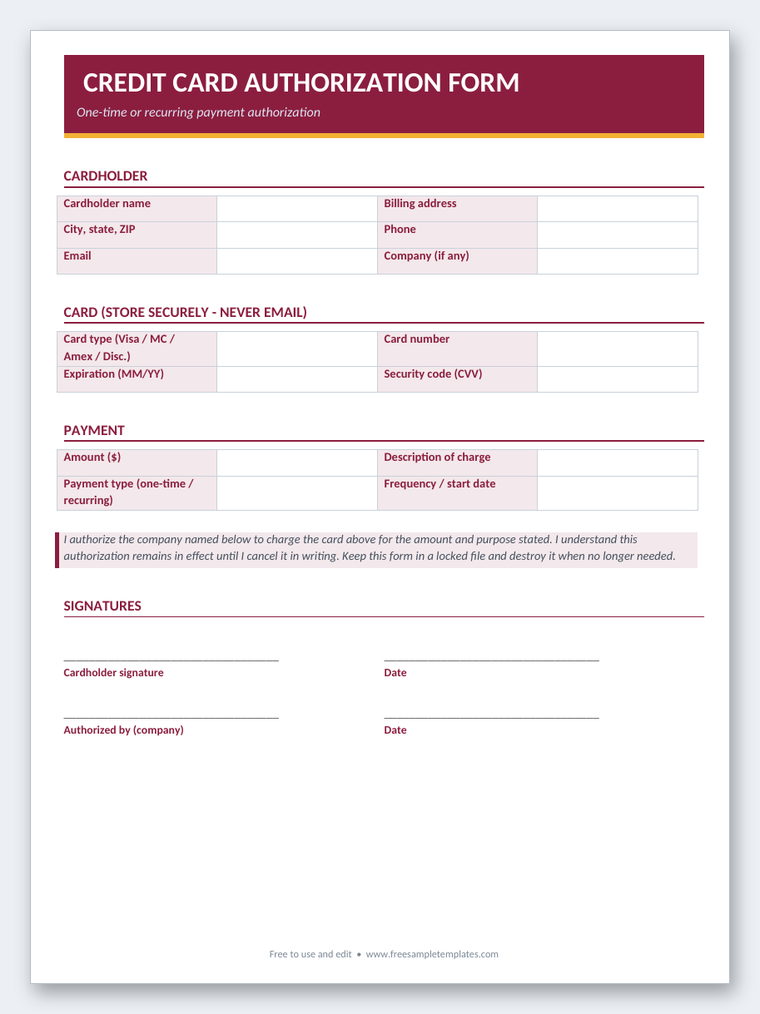

Two new templates to download
Choose the One Time Payment Permission Record for a defined amount and charge occasion. Choose the Recurring Payment Permission Worksheet to describe frequency, amount basis, limits, and the connected provider record.
One Time Payment Permission Record
Document the scope of a proposed charge through a provider-approved payment route.
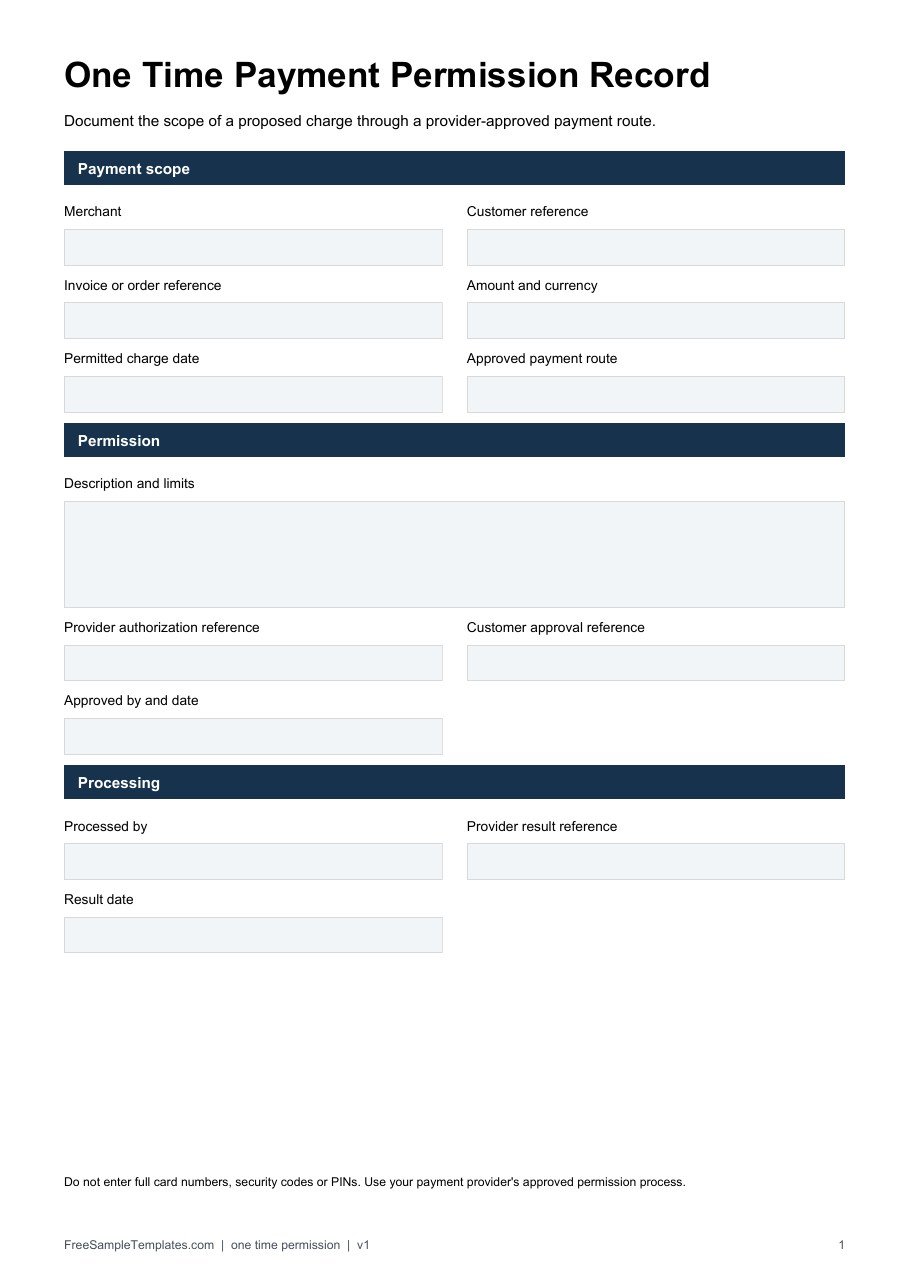
Download One Time Payment Permission Record (PDF)
Recurring Payment Permission Worksheet
Define proposed recurring payment scope and the connected provider record.
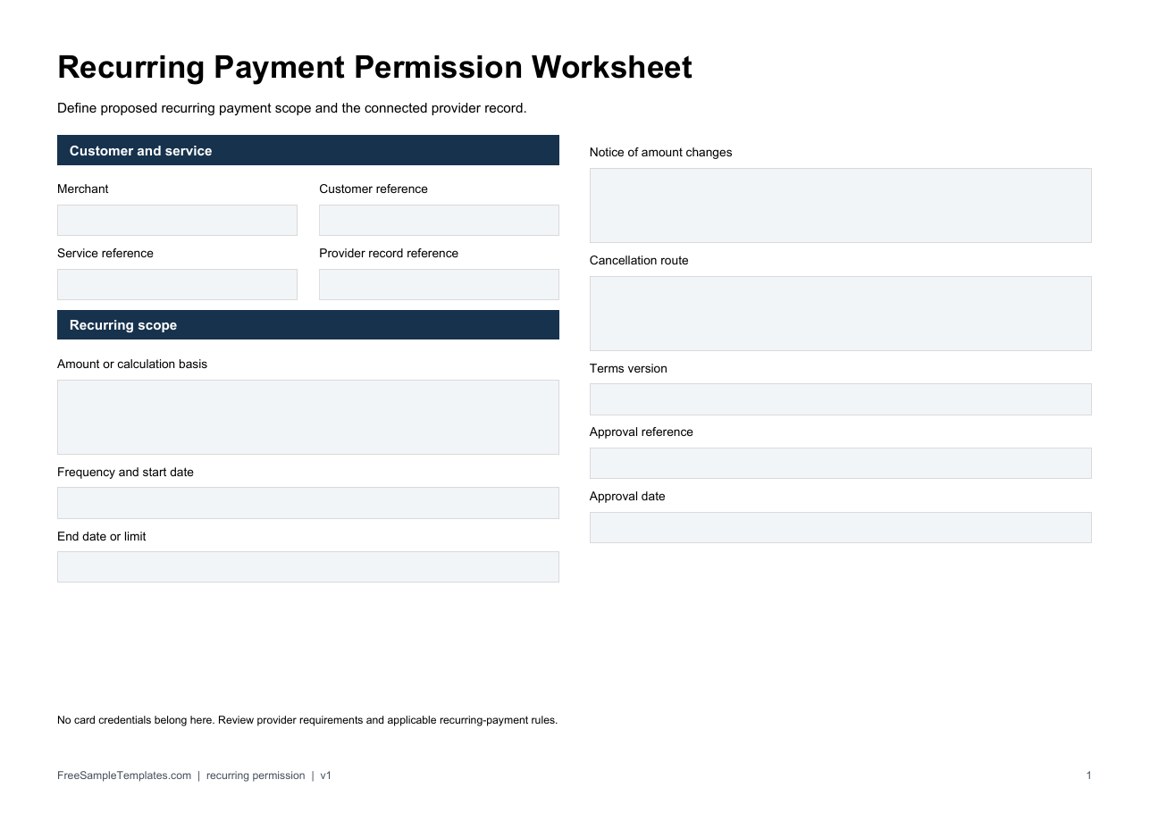
Download Recurring Payment Permission Worksheet (PDF)
How to use the new downloads
Use the payment provider’s approved process to establish permission, then record its reference rather than copying card credentials into these worksheets. The one-time record separates approval from the later processing result. The recurring worksheet provides fields for the start and end conditions, changes in amount, cancellation route, and applicable terms version.
A fictional monthly service could refer to the provider’s existing authorization record and define its approved billing basis without storing a full card number. A proposed change in scope or amount needs review through the proper process. These forms do not submit charges, create a provider token, guarantee compliance, or replace required customer disclosures.
What Is a Credit Card Form?
A credit card form is a document used to collect or document information associated with a credit card payment or authorization. The exact purpose of the form depends on the business and the type of transaction.
For example, a credit card payment form may be used to document a customer’s payment instructions, while a credit card authorization form can be used when a cardholder gives a business permission to charge an agreed amount or according to specified payment terms.
Businesses may encounter these forms in industries such as hospitality, healthcare, professional services, property management, event services, travel, subscriptions, and other businesses that accept card payments.
The form should clearly explain what the customer is authorizing and, where applicable, the amount, payment frequency, purpose of the charge, and other relevant terms.
What Should a Credit Card Form Include?
The information included in a credit card form depends on its purpose. A basic form may contain:
- Customer or cardholder name
- Business or merchant name
- Billing information
- Payment amount
- Payment date
- Description or reason for payment
- Authorization terms
- Recurring-payment information, if applicable
- Signature or other authorization
- Contact information
- Reference or account number
A traditional paper form may also contain fields relating to card details. However, do not add sensitive payment-card information to a template simply because a blank field is available. Businesses should follow their payment processor’s requirements and applicable payment-security standards when handling cardholder data.
Whenever possible, use a secure payment gateway or processor designed to handle payment-card information rather than storing complete card details in ordinary Word documents, spreadsheets, email messages, or unsecured files.
Free Credit Card Form Templates
The five templates on this page provide different starting points for people looking for a credit card form sample or payment-related document.
Sample Credit Card Form
A sample credit card form can help you understand how a card-related payment document may be structured. It can serve as a reference when creating a form for customers or developing internal payment procedures.
Before using a sample for actual transactions, review every field carefully and remove anything that is unnecessary for your particular payment process.
Blank Credit Card Form
A blank credit card form provides a simple starting point that can be customized with your company’s information and payment requirements.
Blank forms can be useful when a business wants to create a consistent document for a particular type of customer transaction. You can add appropriate instructions, payment terms, customer information fields, and authorization sections.
However, a blank form should not automatically be treated as a secure payment method. If your payment process requires cardholder data, use an appropriate PCI-compliant payment solution.
Credit Card Payment Form
A credit card payment form can be used to document payment-related information for a transaction. Businesses may adapt this type of form for customer payments, service charges, deposits, invoices, or other approved payment processes.
A good payment form should clearly identify the transaction and explain what the customer is paying for. If a signature is required, the authorization language should be straightforward and unambiguous.
Credit Card Form Sample
A credit card form sample provides an example of how payment information and authorization details can be organized on a document.
Samples are especially useful when creating a new business form because they can help you determine which sections are relevant and how information can be presented clearly.
Instead of copying a sample exactly, customize it for your company’s actual workflow and payment system.
Credit Card Authorization Form
A credit card authorization form is used when a cardholder gives a merchant permission to process an agreed payment or charge under specified conditions.
For example, a business may need authorization for a particular service, deposit, recurring arrangement, or other transaction. The form should clearly state what the authorization covers and should not contain unnecessary sensitive information.
If you use an authorization form in your business, make sure its procedures are consistent with your payment processor’s requirements and applicable regulations.
Credit Card Authorization Form for Businesses
Businesses sometimes need a written record showing that a customer has authorized a particular payment. A credit card authorization form template can provide a structured way to document that authorization.
The form might identify the customer, merchant, transaction, amount, purpose of the charge, and authorization date. For recurring payments, it may also describe the frequency and conditions under which charges may occur.
The exact requirements vary by payment processor and industry. Therefore, a generic template should be treated as a starting point rather than a substitute for your payment provider’s official authorization process.
Why Use a Credit Card Form Template?
A well-designed form can make payment-related documentation more consistent and easier to understand. Instead of creating a different document for every customer or transaction, a business can maintain a standardized format.
Using a template can help you:
- Save time when preparing payment documents
- Maintain consistent business records
- Clearly document payment terms
- Organize customer information
- Record transaction details
- Document authorization
- Reduce unnecessary paperwork
- Create a professional-looking form
- Adapt the document to different business needs
The most important consideration, however, is security. Convenience should never come at the expense of protecting customers’ payment information.
Printable and Editable Credit Card Forms
An editable credit card form template can be modified to match your company’s branding and requirements. You can add your business name, logo, contact information, instructions, terms, and appropriate fields.
A printable credit card form can be useful for businesses that still use paper-based processes. Before printing a form that could contain sensitive payment information, make sure you have an appropriate method for securely handling, storing, and disposing of completed documents.
For electronic transactions, a secure online payment form or payment processor is generally more appropriate than asking customers to email completed documents containing sensitive card information.
Credit Card Form vs. Credit Card Authorization Form
These terms are sometimes used interchangeably, but they can serve different purposes.
A general credit card form may collect or document payment-related information. A credit card authorization form specifically focuses on the cardholder’s permission for a merchant to process a specified payment or charge.
The correct document depends on what you are trying to accomplish. If your purpose is simply accepting a payment, your payment processor may already provide the appropriate checkout or payment form. If you need written authorization for a specific business arrangement, an authorization document may be more suitable.
How to Customize a Credit Card Form Template
Start by identifying exactly what the form is intended to accomplish. Then select the template that most closely matches your purpose.
Add your company name and contact information and customize the headings and instructions. Include only the information that is genuinely necessary. If the document involves payment-card data, check with your payment processor or compliance professional before adding fields for card information.
Before distributing the form, proofread it carefully and test the workflow. Make sure customers understand what they are authorizing, how much they will be charged, and when the payment will be processed.
Important: These templates are general-purpose document examples and are not a substitute for professional legal, financial, or payment-security advice. Payment-card handling should follow applicable laws, payment-network requirements, and your payment processor’s security procedures.
Choose the record before choosing the layout
Start with the business event. Is a customer selecting an agreed charge, paying an invoice now, or asking staff to reconcile a past transaction? Write that purpose at the top of the proposed document. A form labeled only “credit card details” gives neither the customer nor staff enough context to understand what will happen next.
For an immediate payment, the document can identify the order and point the customer to the provider’s approved payment route. Staff can then record the transaction reference and observed status. For a future charge, the authorization process needs a clearly defined purpose and the terms required by the provider. For an internal record, focus on the amount, invoice, reference, dates, and reviewer rather than reproducing card credentials.
Keep a permission record separate from a processor result. A customer may agree to a charge that is later declined. Conversely, a transaction reference is not the same thing as a signed agreement about future charges. Label each record so the person reviewing it knows which fact it supports. Where records relate to the same customer order, connect them by an identifier rather than copying sensitive details between files.
A fictional deposit example
A design studio quotes a project at 600 and agrees a deposit of 150 with its customer. The payment-related document references quote Q-208, names the service, identifies the merchant, and records the agreed deposit and the customer-facing payment route. It does not copy a card number, security code, or invented signature into an ordinary document.
The staff member sees a pending status in the provider’s system and records that status with its observation time. They do not mark the deposit paid simply because the customer submitted the form. When the provider reports the relevant completed payment status, staff update the record and attach the permitted transaction reference. The original agreement and the result now answer different questions.
Use a payment history record to follow later deposits or balances by their references. If the customer asks to change the amount before processing, follow the approved process and document the revised agreement. Do not treat the original permission for 150 as permission for any later amount. The figures here are illustrative, and the provider’s actual processes determine how a charge is handled.
Separate retained documentation from authentication data
Some historical templates show fields that should not become part of a retained business record. PCI SSC explains that a customer’s permission does not allow an entity to retain a card verification code after the transaction is authorized. Move necessary card-data collection into the organization’s approved payment process rather than copying the historical layout into email or an unrestricted folder.
Review the blank master with the payment provider before using it. Identify which non-sensitive references staff may retain, who can access records, and the applicable retention procedure. A generic template cannot certify compliance or prevent a charge dispute. Staff should also know where to direct a customer who sends card credentials through the wrong route, using the organization’s established incident and data-handling procedure.
Get Credit Card Form Templates:
Frequently Asked Questions
Which card-related document should I choose first?
Choose by purpose: current payment collection, permission for an agreed charge, or internal documentation of a transaction. Then select a layout that supports that purpose and the provider’s actual process.
What formats are the two new downloads?
The two new files are fillable PDFs with different purposes and matching previews. Open them in a compatible PDF viewer, complete the fields and save your copy. They are not DOCX files, and numerical PDF fields do not calculate totals automatically. The original gallery has its own mixed resources and formats.
Does a signed authorization prove the payment succeeded?
No. Permission and processing outcome are separate facts. Record the provider’s actual transaction status and reference through the approved workflow.
Can a customer permit storage of a card security code?
Customer permission does not make post-authorization storage permissible under PCI DSS. Use the approved payment process and keep security codes out of retained ordinary documents.
Should an internal record contain a full card number?
Use only the references your organization’s approved process permits and needs. Do not add complete card credentials to a document merely because an old sample contains fields for them.
What should happen when a transaction remains pending?
Record the observed status and time, and assign a follow-up check under the provider’s process. Do not mark it completed or repeatedly submit it just because confirmation has not arrived.
Can one form cover any future charge?
The authorization must describe the agreed scope and relevant terms. A specific deposit authorization should not be treated as unlimited permission to charge other amounts or services.
Do these templates guarantee compliance or prevent disputes?
No. The document is only one part of the process. Requirements depend on the provider, payment arrangement, applicable rules, and how the information is collected, accessed, and retained.


