
Silent auction bid sheet templates help participants submit offers under clearly stated item and closing rules.
This page now includes two original downloads: Silent Auction Open Bid Sheet and Silent Auction Sealed Bid Form. Choose the Open Bid Sheet when bidders should see earlier offers. Choose the Sealed Bid Form when the organizer’s published rules call for private individual submissions.
The new files appear first with previews and clearly labeled download buttons. The original gallery and its resource examples follow the practical guide; descriptions of the older collection refer to that original gallery. The new PDFs have fillable fields; save a local copy, open it in a compatible PDF viewer, and review the saved result before printing or sharing.
Use this page for the paper-sheet workflow. The auction bid sheet overview explains how field choices depend on the bidding method. A guest list can help organize attendees, but bidder registration and item bids need their own clear identifiers. Keep the records connected without making the public item sheet a directory of personal contact details.
Two new templates to download
Choose the Open Bid Sheet when bidders should see earlier offers. Choose the Sealed Bid Form when the organizer’s published rules call for private individual submissions.
Silent Auction Open Bid Sheet
Display one item and collect bidder-number offers in increasing amounts.
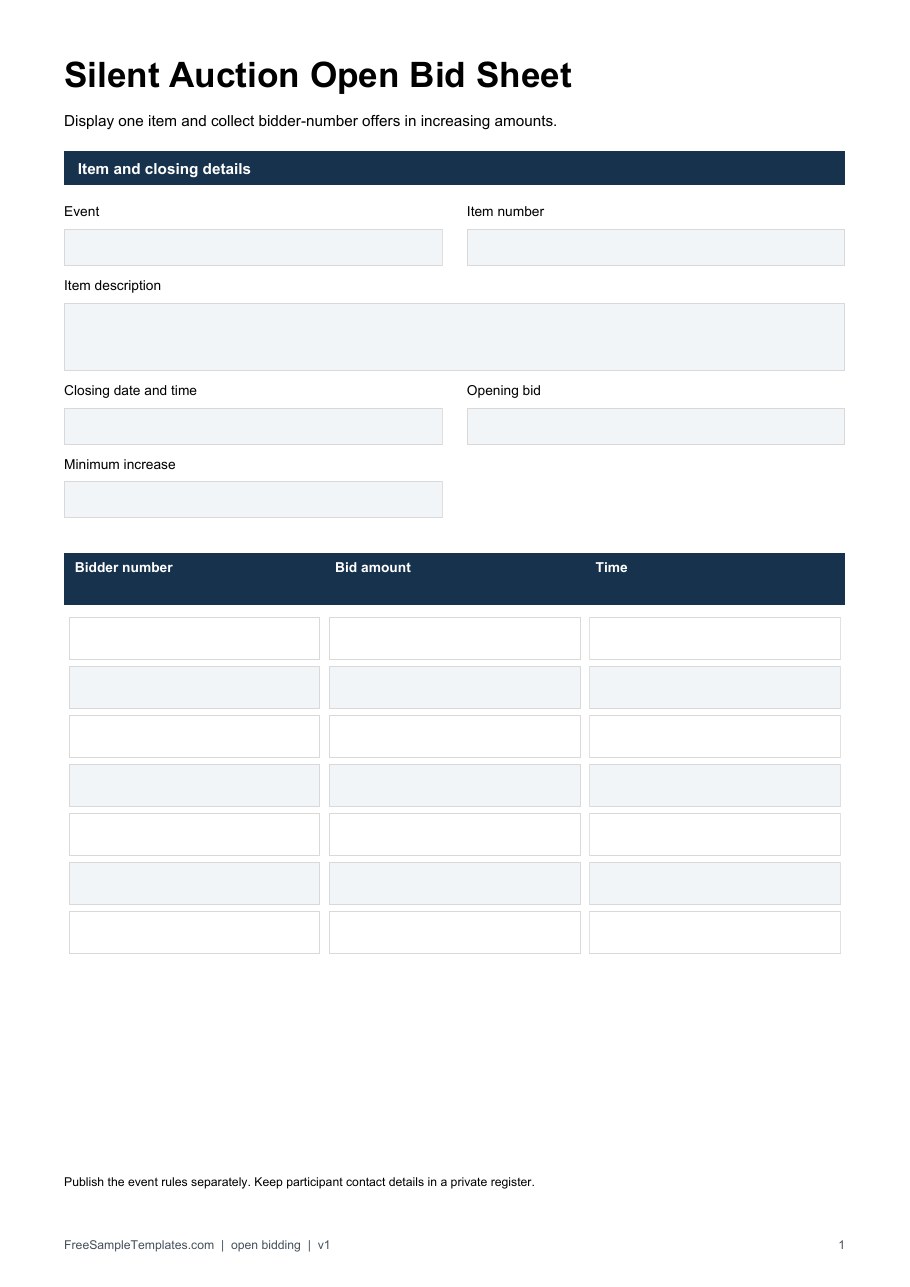
Download Silent Auction Open Bid Sheet (PDF)
Silent Auction Sealed Bid Form
Receive private individual offers and document the organizer’s receipt.
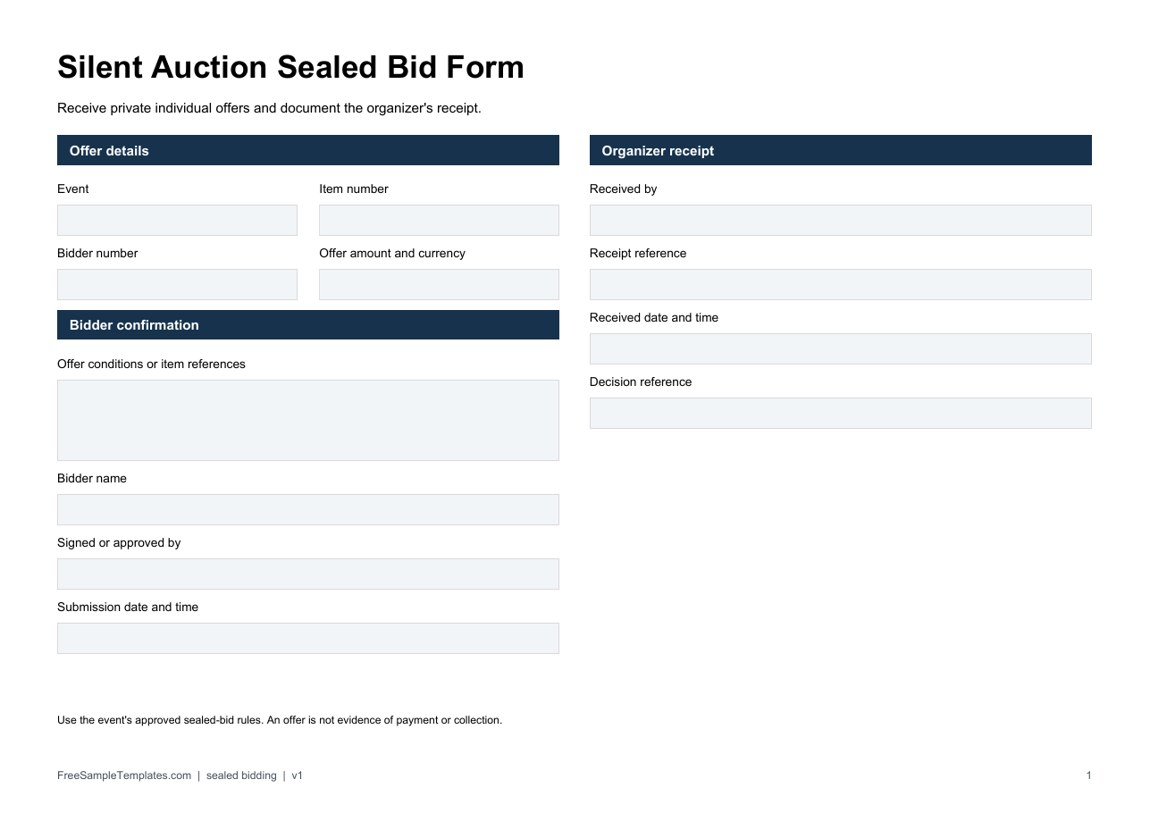
Download Silent Auction Sealed Bid Form (PDF)
How to use the new downloads
For open bidding, complete the item number, opening amount, minimum increase, and closing time before displaying the sheet. Use bidder numbers so public sheets do not become contact directories. For a sealed bid, prepare one form per submission and record the organizer’s receipt separately from the bidder’s approval.
If a fictional item opens at 50 with a minimum increase of 5, the organizer should explain how a later offer qualifies under the event rules before bidding begins. A sealed-bid process instead needs a defined submission route, receipt record, and decision process. Keep the accepted offer connected to later payment and collection records; the bid form itself records neither event.
Prepare one controlled sheet for each item
Assign a unique identifier to the item, then put that identifier on its bid sheet, display description, and the staff record used for results. Similar item names can cause mistakes during a busy event. A number such as A-021 is easier to trace than “gift basket” when several baskets are available.
Write the description from the actual item offer. State the included goods or service and relevant restrictions, using the provider’s real conditions. An experience may involve booking, a limited period, or a specified number of participants. Those conditions should be available before participants bid; do not leave the collection team to explain an important exclusion after a winner is selected.
Add the event’s opening bid, minimum increment, currency, and closing information in separately labeled fields. Keep any estimated value separate from these bidding amounts. An opening price is not a valuation, and an accepted bid is not confirmation of payment. Use the same rule wording across the sheet and the event instructions.
Keep a clean blank master apart from completed item sheets. When creating the next sheet, check the identifier, description, amounts, and restrictions instead of copying the previous item’s populated page without review. A consistent layout is helpful only when its item-specific details are correct.
Plan bidder identification and writing space
Choose the identification method under the event’s actual process. If participants use bidder numbers, show the number field clearly and tell them how to obtain their number. Keep the registration details in the record maintained by authorized staff rather than asking participants to display full contact details beside every item.
Make the amount field wide enough for legible entries and label the currency. Leave sufficient row height for handwriting. A dense table may fit more offers on one sheet but create ambiguous digits and cramped names. The useful capacity is the number of entries staff can read reliably, not the maximum number of narrow rows that fit on a page.
Prepare a continuation procedure for a full sheet. A continuation page should show the same item identifier and its relationship to the original. Keep the pages together through the event’s established process. Do not print an independent second sheet that lets two competing bid sequences develop beside the same item.
Fictional example: one item through bidding
Imagine an invented community event offering a garden basket identified as A-021. Its sheet lists the included contents, an illustrative opening bid of 40, and an increment of 5. Participant 118 records 40, participant 126 records 45, and participant 118 later records 55. These are fictional identifiers and amounts used to show a sequence, not prescribed event rules.
An entry of 57 appears next. Under the illustrative rule requiring a minimum increase of 5 from the current bid, that entry needs review because the previous offer was 55. Staff use the stated event procedure rather than simply selecting the largest written figure. If the rule or its application is unclear, the designated reviewer resolves it consistently and records the decision.
A participant then asks whether the basket includes delivery. Staff check the actual description and explain the stated terms. They do not add a new benefit that the donor did not offer. If the description contains an error, the organizer handles the correction and any affected bids through the event’s process rather than quietly rewriting the display.
The example shows why readable entries, accurate item descriptions, and established rules matter together. A sheet cannot make every offer valid simply by providing a blank row. Volunteers need a clear route for questions and review before the event becomes busy.
Close bidding and secure the record
State who closes the item or section and how the closing moment is communicated. Staff should follow the same published process rather than using a different interpretation at each table. Remove or control access to the completed bid record as required by the event’s procedure so later entries do not create confusion about the cutoff.
Review the completed sheet against the stated rules. Check the item identifier, eligible entries, readable amounts, bidder identification, and any recorded correction or exception. A final amount copied into a summary should still be traceable to its original row. If staff cannot interpret an entry reliably, they should use the designated review process rather than guess.
For tied or disputed bids, use the rule the event established and communicated. This guide does not invent a universal tie-breaking rule. Document the result and who reviewed it so the payment team receives a clear accepted bidder and amount rather than an unresolved sheet with a circle around a number.
Separate winner, payment, and collection
The result record identifies the accepted bidder and amount. The payment process confirms what was paid, when, and through which approved route. The collection process records which item was released and to whom. These are connected steps, but they are different events and should have distinguishable statuses.
A winning bidder may not have paid yet. Do not mark the payment complete simply because staff notified the winner. Use the event’s approved payment route and record the permitted reference needed to trace the transaction. Keep card credentials out of the bid sheet and any broadly shared checkout list.
At collection, match the item identifier and accepted bidder through the actual process. If two similar baskets are stored together, the identifier is more reliable than a general description. Record a later pickup arrangement when needed instead of treating an item left at the venue as already released.
Where the organization provides a cash receipt for an actual cash payment, connect it to the appropriate payment record. The bid sheet itself is not a receipt, and no receipt should be invented for an unconfirmed payment. Use the organization’s actual document and recordkeeping process.
Review the event records afterward
Compare accepted results with payments and released items. Keep unpaid, uncollected, or unresolved items visible with the person responsible for follow-up. Do not force every item to a completed status merely because the event has ended. The review should show what happened and what remains to be resolved.
Preserve the original completed sheets and supporting references according to the organization’s actual requirements. If a later correction is necessary, use the established correction process instead of erasing the history. Keep unused blank sheets separate so an empty form cannot be mistaken for a missing result.
For charitable auctions, do not assume the whole winning bid is a tax-deductible contribution. IRS charity-auction guidance addresses the value the purchaser receives and other conditions in the US context. Applicable documentation and tax treatment depend on the jurisdiction and circumstances; a bid sheet does not decide the purchaser’s deduction or replace the organization’s required documentation.
Download Silent Auction Bid Sheet Templates Below:
Silent Auction Sheet
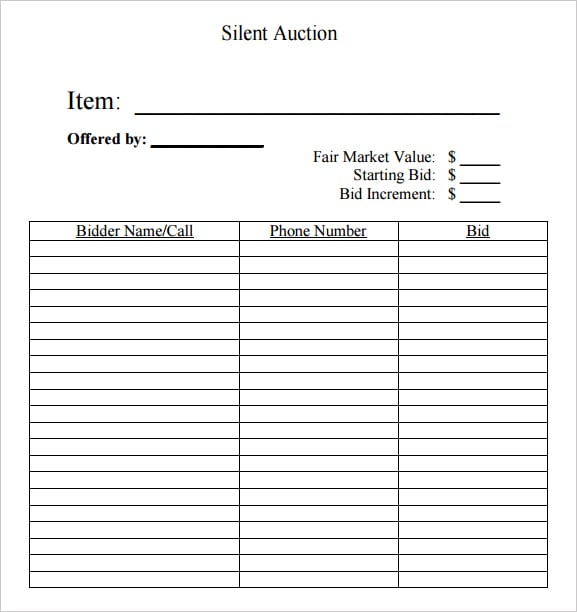



Silent Auction Bid Sheet Sample Images:
Silent Auction Bid Sheet

Silent Auction Bid Sheet Sample

Silent Auction Bid Sheet Printable

Fundraising Silent Auction Bid Sheet

Template For Silent Auction Bid Sheet

Frequently Asked Questions
What formats are the two new downloads?
The two new files are fillable PDFs with different purposes and matching previews. Open them in a compatible PDF viewer, complete the fields and save your copy. They are not DOCX files, and numerical PDF fields do not calculate totals automatically. The original gallery has its own mixed resources and formats.
Should each item have its own bid sheet?
For the item-specific paper workflow described here, use a clear record for each item. Keep its identifier consistent across the display, bid sheet, result, and collection records.
What belongs on a continuation sheet?
Show the same item identifier and the continuation relationship, and keep the pages together through the event’s process. Avoid creating a competing independent sheet.
Is the highest written figure always the accepted bid?
Review eligibility and entries under the event’s stated rules. An amount can be high while still failing an increment rule or having an unresolved identification issue.
How should tied bids be handled?
Use the event’s established and communicated rule and designated reviewer. Do not improvise a different tie-breaking method at each table.
Does winner notification mean payment is complete?
No. Record the result, actual payment confirmation, and item release as separate events. A winner may still have a payment or pickup step outstanding.
Should card information go on the bid sheet?
Use the approved payment route. The public or shared bid record should identify offers and participants through the event’s process, not collect card credentials.
Is a winning bid automatically fully deductible?
No. Applicable treatment depends on the jurisdiction, value received, and other conditions. The bid sheet is not a tax receipt or a determination of a deduction.


