
A trailer bill of sale template records the parties, trailer description, agreed price and transaction date. Verify identifying details and state the actual terms rather than relying on a generic description. The record supports the sale but does not independently confirm ownership or completion of transfer procedures.
Keep payment events in a payment history record, compare sale-document purposes in the sales receipt guide and prepare a checklist for the documents and equipment included. Reference the same trailer identifier throughout and verify applicable transfer requirements separately.
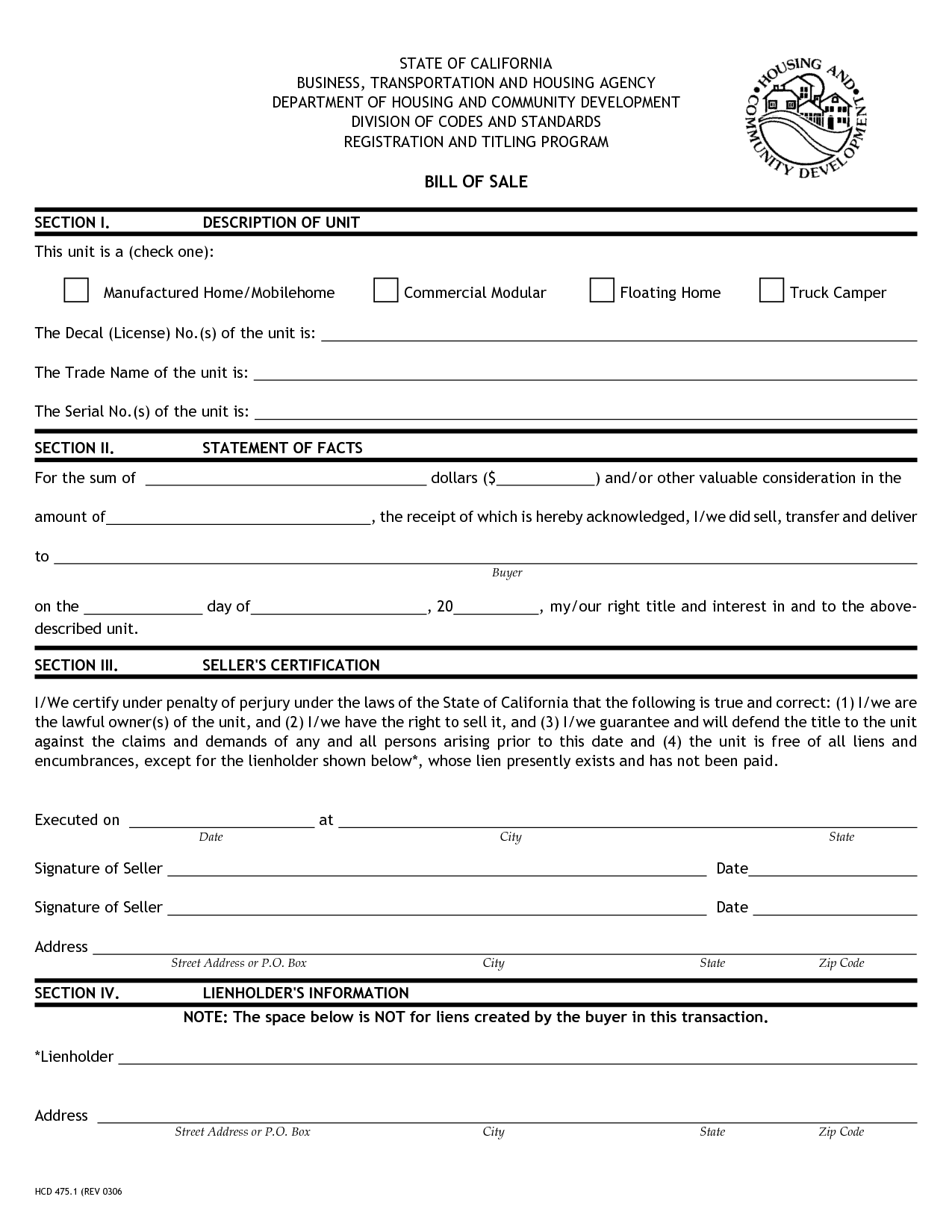
The five original previews below link to ZIP archives. One destination names a vessel resource, so inspect its contents and suitability before using it for a trailer-only transaction. The archive names and captions do not establish that every form matches your location or trailer type.
The boat bill of sale guide distinguishes vessels from trailers, a cash receipt acknowledges an actual received payment, and the two-party agreement guide discusses general agreement structure. Keep the trailer record connected to the real transaction without assuming those documents complete every official step.
What Is a Trailer Bill of Sale?
A trailer bill of sale is a written record showing that a trailer has been sold or transferred from one party to another. It can provide evidence of the transaction and preserve important details about the trailer and agreed purchase price.
A typical trailer bill of sale form identifies the buyer and seller and describes the trailer being transferred. Depending on the circumstances, it may include the trailer make, model, year, VIN or identification number, registration information, purchase price, payment details, and signatures.
Free Trailer Bill of Sale Template
A free trailer bill of sale template provides a convenient starting point for documenting a private trailer sale. You can customize the form with the actual transaction details and print copies for both the buyer and seller.
A properly completed bill of sale for a trailer can help both parties maintain a record of the purchase. It is important to enter the trailer information accurately and retain any other documents required for registration or title transfer.
What Information Should a Trailer Bill of Sale Include?
A trailer bill of sale template may include the names and addresses of the buyer and seller, date of sale, trailer description, make, model, year, identification number, purchase price, payment terms, and signatures.
Additional statements may be appropriate depending on whether the trailer is sold as-is, whether there are warranties, or whether specific conditions were agreed between the parties.
Requirements for a trailer bill of sale can vary by location and by trailer type. Before completing a transaction, check the applicable requirements of the relevant motor vehicle or registration authority.
Printable Trailer Bill of Sale
A printable trailer bill of sale form is useful when both parties want a physical record of the transaction. After completing the form, the buyer and seller can retain signed copies with their other vehicle and ownership documents.
An editable trailer sale agreement can also be customized before printing so that the document reflects the specific transaction.
Trailer Bill of Sale for Private Sales
A private-party trailer bill of sale is commonly used when an individual sells a trailer directly to another individual. The document should accurately identify the parties and trailer and clearly state the agreed sale price.
Before signing, both parties should review all information carefully. The buyer should also verify the trailer’s identification information and any available ownership or title documentation.
A bill of sale is an important transaction record, but it may not by itself transfer legal title or satisfy registration requirements. Those requirements depend on the applicable jurisdiction.
Check the relevant authority’s requirements first
Identify the trailer’s type and the jurisdiction handling the transfer or registration. Requirements can depend on those circumstances. A general template should be reviewed against the authority’s actual instructions before parties rely on it.
New York DMV ownership guidance distinguishes title or transferable-registration evidence from other transaction documents and discusses different circumstances. It illustrates why a bill of sale alone is not a universal replacement for the required ownership paperwork.
Use the relevant authority’s current forms and instructions for the actual transaction. This article does not set a universal weight threshold, title exemption, tax rate, or notarization rule. A form suitable elsewhere may be incomplete for your trailer or location.
Identify the trailer separately from associated equipment
Record the relevant trailer description and identifier accurately. A boat carried on a trailer is a separate item, and an attached towing vehicle is not automatically included. Define what the transaction actually covers before copying a combined-resource layout.
Where a sale includes accessories, name them clearly and distinguish any separately identified items. The buyer and seller should not need to guess whether a spare part or separate piece of equipment is included merely because it appears near the trailer.
Check identifiers against the actual item and relevant documents through the appropriate process. Do not invent a number when one is missing or difficult to read. An unresolved identification issue should remain visible for review rather than be hidden by a neat typed field.
Match the seller and supporting documents
Confirm the seller’s identity and claimed authority through the process appropriate to the transaction. A person possessing a trailer is not automatically established as authorized to transfer it. The bill of sale’s name field cannot resolve that issue by itself.
Review the relevant title or other ownership documents and any recorded interests according to the applicable process. This guide does not prescribe a universal search or establish that a particular document proves clear ownership in every jurisdiction.
If information conflicts, address the discrepancy before treating the paperwork as complete. A different identifier or owner name may need an appropriate explanation and correction. Do not silently change an official document or choose whichever entry is easiest to copy.
State price and payment status clearly
Separate the agreed purchase price from the amount actually paid. A deposit or installment can be recorded accurately without implying full settlement. The parties’ real agreement should describe what happens next rather than relying on an ambiguous paid line.
Identify payment references where the process requires them and use the appropriate acknowledgment for actual receipt. A bill of sale can record the price while a receipt documents a particular payment. Their relationship should be clear enough to avoid treating one amount as two payments.
Do not infer tax treatment from a generic template. The applicable authority’s process determines any required declarations and charges. A transaction price does not automatically establish the final amount owed under every registration or tax requirement.
Fictional example: a trailer with an accessory
Imagine an invented sale of a utility trailer for one thousand units of currency with a named spare wheel included. The record identifies the trailer and the included accessory, while a separate towing vehicle is expressly outside the stated transaction.
The buyer has paid a two-hundred-unit deposit under the example’s arrangement, leaving eight hundred of the price unpaid. The record distinguishes that payment from the full price and identifies the relevant remaining step. It does not claim that recording a deposit completes title transfer.
At handover, the parties use the appropriate local process and supporting documents. The bill of sale can record the actual transaction date and terms without substituting for an authority’s required application or ownership evidence.
These figures illustrate scope and payment distinctions only. They are not a recommended valuation, tax calculation, or legal form. A real sale needs the actual identifier, price, terms, parties, and applicable requirements.
Keep condition statements factual
Describe known condition information accurately through the actual agreement and appropriate review. A template is not a mechanical inspection or certification of safe use. The existence of a signed page does not establish the trailer’s roadworthiness or suitability for a particular load.
An as-is phrase does not automatically remove every legal obligation or decide every buyer right. Its effect depends on the applicable law and circumstances. Avoid copying such wording as a guarantee that no later dispute or responsibility is possible.
Keep any actual promises distinguishable from descriptions. If a statement concerns a repair, included equipment, or inspection, identify the real basis and relevant record. Do not convert a sample sentence into a promise neither party has agreed.
Inspect the archived forms before adapting them
The original ZIP resources have different names and apparent contexts. Review the actual contents, issuer, jurisdiction references, and required fields. A form bearing another authority’s heading may be inappropriate for a transaction elsewhere.
One destination names a vessel resource, which may not supply the trailer-only record you need. Inspect its scope instead of assuming every gallery item is interchangeable. A combined boat-and-trailer document needs separate identification of the actual items.
Clear example names, identifiers, prices, dates, and completed marks from any reusable master. Use the applicable process for signatures and supporting documents. The template can supply a structure while the actual requirements determine how the record is completed.
Preserve copies and remaining actions
Ensure the parties’ relevant copies describe the same transaction. Keep the record connected to supporting documents and the appropriate authority’s process. A signed bill of sale should not make an outstanding registration or title step disappear from the task list.
If a correction is needed, follow the applicable procedure and preserve its relationship to the original. Do not alter official records informally or issue conflicting transaction copies. Clear versions help explain what the parties actually agreed and recorded.
A useful trailer bill of sale supports an accurate account of a specific sale. It does not guarantee ownership, safe operation, or acceptance by every authority. Precise identification, honest payment status, relevant documents, and the correct local process give the record practical value.
Get Trailer Bill Of sale Templates:
Bill Of sale For Trailer
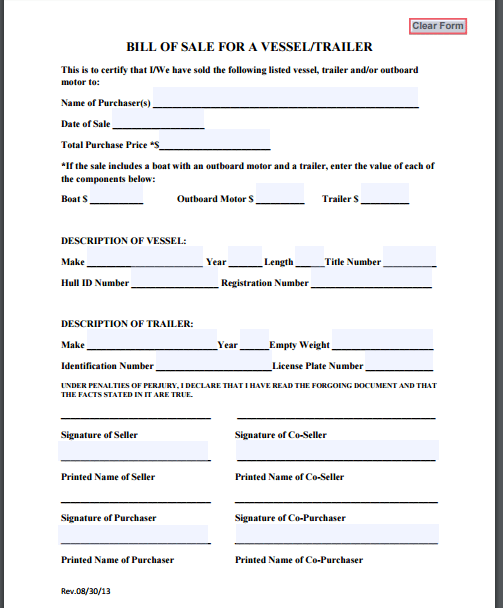

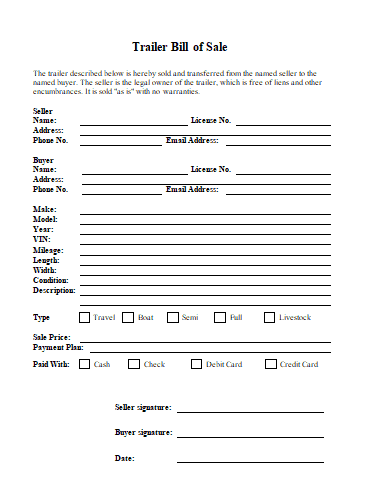
Trailer Bill Of sale Sample
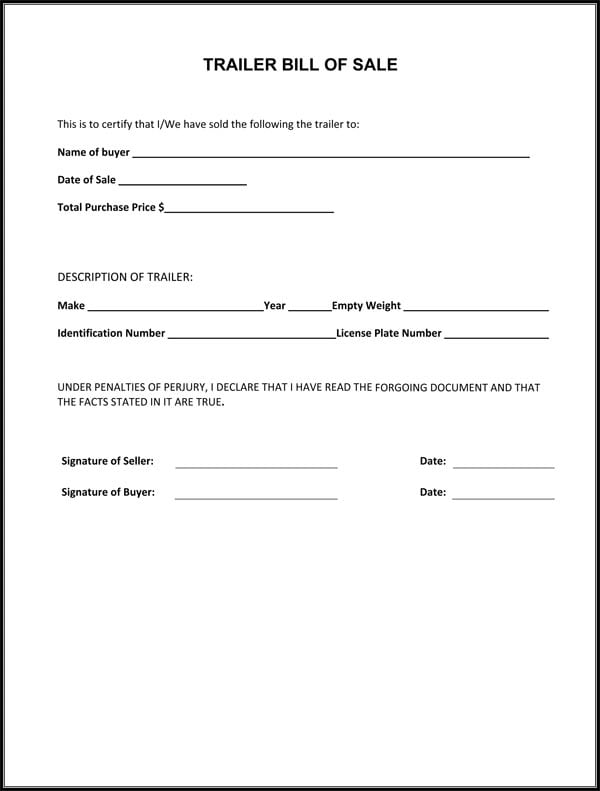
Printable Trailer Bill Of sale
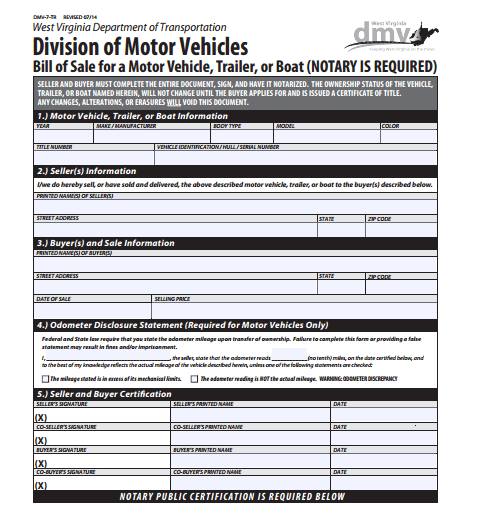
Bill Of sale Example
Frequently Asked Questions
Does a bill of sale alone complete trailer title transfer?
Not universally. Check the relevant authority’s current requirements for the actual trailer and transaction.
Are the five resources direct Word documents?
The preserved destinations are ZIP archives. Inspect their contents and jurisdiction references before selecting a usable form.
Why does one archive name a vessel?
The original resource has that destination name. Review its actual scope before using it for a trailer-only sale.
Should a boat and trailer share one identifier?
No. They are distinct items and need appropriate separate identification when both are included in a transaction.
Does an as-is phrase remove every obligation?
Its effect depends on applicable law and circumstances. A generic phrase does not guarantee a particular legal result.
Can the record show a deposit?
Yes, if accurate. Distinguish the agreed price, amount paid, and remaining payment rather than implying full settlement.
Does the document certify roadworthiness?
No. A transaction record is not a mechanical inspection or certification of suitability for use.
What if the identifier conflicts with supporting paperwork?
Address the discrepancy through the appropriate process. Do not invent a replacement number or silently alter official information.


