
A boat bill of sale template records the parties, vessel details, transaction price and actual terms. Identify included equipment and distinguish any trailer from the boat itself. Check the source details and applicable transfer process rather than assuming the sale record alone completes ownership formalities.
Use the trailer bill of sale guide for a separately identified trailer, a cash receipt for received cash and a payment history template for installments or outstanding amounts. Use matching identifiers across the documents without merging different assets or payment events.
The four previews below have three original external destinations and one unlinked download graphic. The linked resources include a download route, a Hawaii-captioned boat-and-trailer PDF, and an Illinois resource page. They are not four confirmed editable Word files suitable for every location.
The trailer bill of sale guide covers the trailer as a separate item, a cash receipt acknowledges an actual received payment, and the two-party agreement guide explains general agreement structure. A boat sale needs its own accurate scope and the appropriate authority’s process.
Identify the vessel and applicable process
Start with the actual boat and the jurisdiction or documentation process relevant to it. Vessel type, previous ownership records, and other circumstances can affect the required paperwork. A generic form should be checked against the real authority’s instructions before it is relied on.
New York DMV's boat registration and titling instructions identify a bill of sale alongside separate ownership and other required documents in relevant circumstances. This is one jurisdiction’s example, illustrating why the sale record is not automatically the complete transfer process.
Use the appropriate local or documentation authority for the actual vessel. This guide does not supply universal registration exemptions, fees, tax rules, or deadlines. A form naming one state does not establish suitability for a boat transaction elsewhere.
Describe the boat accurately
Record the vessel’s make, model, year, and relevant hull identification information through the actual process. Use the correct identifiers from the vessel and supporting documents rather than copying sample numbers. A description should identify the item being transferred clearly.
Keep a registration number distinguishable from a hull identifier when both appear. They serve different functions and should not be exchanged simply because one fits the available field. Follow the applicable requirements for the actual document.
If an identifier is missing, unreadable, or inconsistent with the records, address that issue through the appropriate authority or review process. Do not invent a replacement number to finish the page. The unresolved question matters more than a complete-looking sample.
Separate the boat, motor, trailer, and accessories
Define exactly what the sale includes. A boat, outboard motor, and road trailer can have different identifiers and documentation needs. A combined form should not merge them into one description that leaves the included items uncertain.
List relevant accessories or other included equipment clearly. If a particular item is excluded, the actual agreement should make that distinction understandable. An item visible in a preview or photograph is not automatically included in the transaction.
Check any required allocation of prices through the applicable process. A combined price can describe the parties’ commercial arrangement while an authority may need more detail. Do not invent an allocation merely because a sample includes separate price boxes.
Review the seller’s authority and supporting records
A seller’s name on a bill of sale does not independently establish the right to transfer the vessel. Review the appropriate ownership and other supporting information for the actual transaction. Possession of the boat alone should not be treated as completed ownership verification.
If recorded interests, liens, or other issues are relevant, follow the applicable review and release process. This article does not establish that a generic statement proves the vessel is free of every interest. The actual evidence and rules determine that question.
Address discrepancies before treating the paperwork as final. A conflicting owner name or identifier can need clarification through the relevant authority. Do not silently alter an official document or rely on a typed sales form to make the conflict disappear.
Make the price and payment record clear
Write the actual agreed price and currency. Distinguish that amount from a deposit or other payment already received. A bill of sale can record the transaction price without claiming that the entire amount has been paid.
Identify the payment arrangement and relevant references according to the real agreement. A receipt acknowledges a particular received payment, while a broader payment record can show the remaining obligation. Keep these functions clear to avoid duplicate or misleading amounts.
Do not label a transaction fully settled because a sample contains paid-in-full wording. That conclusion needs the actual facts and terms. A future payment commitment and an actual received amount are different events.
Fictional example: a boat sold with a trailer
Imagine an invented sale including a boat, a separately identified trailer, and specified equipment for a total price of four thousand units of currency. The record names each included item and its relevant identifier. A separate towing vehicle is outside the stated transaction.
The buyer has paid a five-hundred-unit deposit under the fictional arrangement, leaving three thousand five hundred of the price unpaid. The form identifies the deposit rather than describing four thousand as already received. The parties’ actual remaining steps stay distinguishable.
At handover, the appropriate ownership documents and authority requirements are handled through their real processes. The bill of sale records the sale details, while delivery, payment, and registration or documentation each need their own accurate status.
These amounts illustrate scope and arithmetic only. They are not a recommended valuation, tax allocation, or legal form. A real transaction needs the actual vessel details, supporting records, agreement, and applicable requirements.
Keep condition and inspection separate from paperwork
A bill of sale is not a survey, mechanical inspection, or certification that a boat is suitable for a particular use. A signed page does not establish seaworthiness. Any actual inspection or survey needs the appropriate scope and competent process.
Describe known condition information accurately and keep actual promises distinguishable from general descriptions. A statement that equipment is included differs from a statement about its working condition. Do not copy a sample assurance without a factual basis and real agreement.
As-is wording does not automatically remove every obligation or decide every legal right. Its effect depends on the applicable law and circumstances. Avoid treating it as a guarantee that no dispute or responsibility can arise after the transaction.
Select the resource according to its actual context
The original Hawaii-captioned PDF and Illinois resource page have jurisdiction-specific contexts. Review the actual form, issuer, dates, and instructions. A resource’s availability does not establish that another authority will accept it.
The download route’s URL does not identify all features of the file it supplies. Inspect the actual format before expecting editable Word tables or automatic calculations. The unlinked graphic is a preview element rather than a functional download.
Use a sample as a structure to review, while the applicable authority and real agreement determine what the transaction needs. A mismatched form may omit required fields or contain provisions inappropriate to the actual boat and location.
Complete and retain consistent records
Review the parties, identifiers, included items, price, payment status, dates, and terms before using the final document. Follow the applicable signature, witnessing, or other requirements rather than assuming a generic signature line settles every formality.
Keep the parties’ relevant copies consistent and connected to supporting records. If a correction is needed, use the appropriate process and identify its relationship to the original. Conflicting copies can make a later question harder to resolve.
Do not mark every transfer task complete merely because the sale form is signed. Track any remaining authority submission, documentation, or other step through the real process. The record should reflect what actually happened rather than the desired end state.
Prepare a blank master carefully
Remove example party names, identifiers, dates, prices, and completed marks before reusing a layout. Retain appropriate field labels and current instructions. Another sale should not carry forward details from the previous vessel.
Keep a completed bill of sale distinguishable from the blank master and any public sample. Demonstration documents should use invented data. A real transaction record can contain personal and ownership information that does not belong in a broadly shared design example.
A useful boat bill of sale makes a defined transaction easier to communicate and review. It does not guarantee ownership, safe operation, or acceptance by every authority. Its practical value comes from precise scope, accurate details, honest payment status, and the correct transfer process.
Download Boat Bill Of Sale Form Templates Below
Sample Boat Bill Of Sale
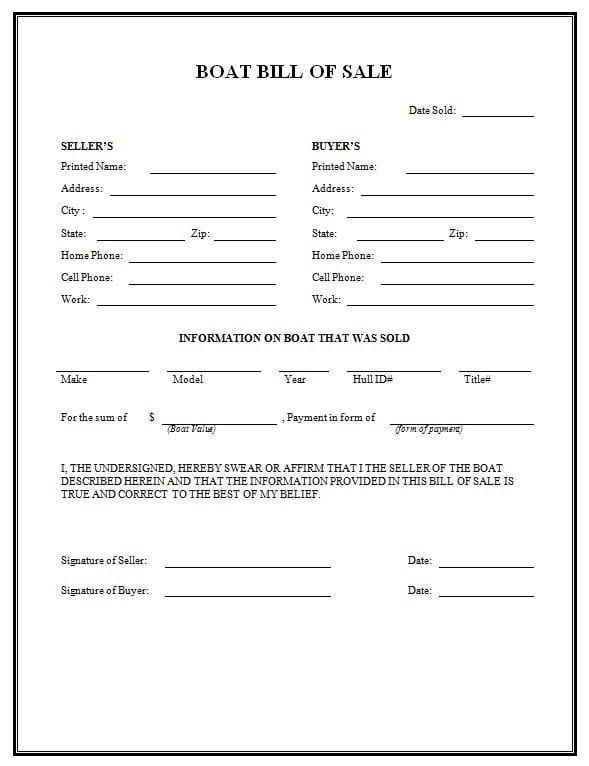

Boat/Trailer Bill Of Sale

Blank Boat Bill Of Sale

Printable Free Boat Bill Of Sale

Frequently Asked Questions
Does a bill of sale complete every boat transfer requirement?
No. Check the relevant authority’s current ownership, title, registration, or documentation requirements for the actual vessel.
Are all four resources editable Word files?
The preserved destinations are mixed external resources, and one graphic is unlinked. Inspect the actual resource before assuming a file format.
Should the trailer have its own description?
Yes, when included. A boat and trailer are separate items with their own relevant identification and documentation.
Can a state-specific form be used everywhere?
Do not assume so. Review the actual jurisdiction and authority requirements before selecting a form.
Does the form establish seaworthiness?
No. It is a transaction record rather than a survey or safety certification.
Can I record a deposit on the document?
Record it accurately where appropriate and distinguish it from the agreed price and any unpaid amount.
What if an identifier conflicts with official paperwork?
Address the discrepancy through the appropriate process. Do not invent a number or informally alter official records.
What should be cleared from the reusable master?
Remove actual party details, vessel identifiers, prices, dates, and completed marks while retaining the appropriate blank structure.


