
A cleaning list template assigns specific work to areas and people and records whether it was completed. State the expected task and relevant instructions, then leave room for exceptions or access issues. A checked row should reflect observed work rather than an assumed result.
Assign follow-up through a task list, record observations in a daily log and hand unresolved issues to the next team using a shift report. Reference the area and date so repeated problems can be reviewed instead of disappearing into new blank lists.
The six previews below link to mixed external resources: three PDF destinations, two article or resource pages, and a route naming an XLS spreadsheet. Two previews use the same PDF, so the collection is not six distinct editable files. Review the selected resource’s actual format and purpose before adopting it.
Use this overview for the structure of a particular cleaning session. The house cleaning list guide focuses on recurring household responsibilities. A general checklist explains observable checks, while a maintenance request records issues needing a different process from ordinary cleaning.
Define the area and purpose
Write the room or area covered, the occasion or period, and the person coordinating the work. Preparing one meeting room after an event is more specific than cleaning an entire building. The scope tells users which tasks belong in the session and which need another record.
Distinguish cleaning from maintenance, repairs, and specialist work. A damaged fitting or equipment fault does not become an ordinary cleaning task merely because someone noticed it during the session. Record the observation through the appropriate process and avoid assigning work outside the person’s role or competence.
A household sample is not an approved healthcare or other specialist facility procedure. Such settings have their own requirements and trained users. The template supplies a planning layout rather than the correct method for every surface, risk, or organization.
Choose a structure suited to the work
A room-based list groups tasks by location. A task-based layout groups similar activities across areas. A frequency-based layout separates recurring periods. Choose the structure according to how the work is assigned and reviewed, rather than copying every category from a sample.
For one session, a date and clear scope may be more useful than a long annual calendar. For recurring work, the master can define tasks and agreed intervals while a completed copy records a particular period. Keep standing instructions separate from actual completion records.
Write enough detail to identify the activity. A row can name the meeting table and refer to the approved cleaning instructions. The actual method still comes from the relevant surface, product, or workplace procedure, not from an unsupported generic label.
Keep instructions traceable
The task row should name what needs attention and point to the relevant instructions. Long product or equipment directions belong in their appropriate source rather than being shortened into an incomplete phrase in a narrow cell. A planning list should not lose essential conditions merely to save space.
CDC guidance advises following product-label instructions and not mixing products or chemicals. Use the actual instructions for the product, surface, and setting. This guide does not supply a chemical recipe, universal contact time, or substitute procedure for specialist work.
If a task requires a particular approved resource or trained user, make that dependency clear. Do not present it as ready to perform when the instruction or resource is missing. An awaiting-clarification status is more accurate than a prompt to improvise.
Fictional example: an office meeting room
Consider an invented session after a small office event. The coordinator records the room, date, assigned person, and areas to review under the office’s procedure. The list separates clearing ordinary materials, returning reusable items to their designated place, and cleaning the surfaces covered by approved instructions.
During the session, a damaged chair fitting is noticed. The person follows the maintenance reporting route and adds the request reference where useful. The cleaning record does not claim the chair is repaired simply because the cleaning session ends.
One surface cannot be addressed until the appropriate instruction is confirmed. Its row stays unresolved and identifies the coordinator’s next check. Other work can be reported accurately without turning that unresolved task into a completion tick merely to finish the page.
This example illustrates assignment and documentation, not a cleaning procedure for a particular material. A real list needs the actual scope and approved instructions. Invented dates, products, or completion claims should not be copied into the working record.
Make ownership and timing clear
Give tasks or groups of tasks a clear owner and identify who reviews exceptions. A list assigned to everyone may leave each person assuming someone else will handle it. Where several people share a session, clarify the boundaries to avoid duplication and missed areas.
Keep the requested timing separate from actual completion. If work needs to occur around another activity, record that constraint. The same arbitrary deadline for every task does not establish that the sequence is realistic or that access will be available.
Estimated durations can support planning but should not be presented as guarantees. If the scope changes or an instruction needs review, adjust the assignment through the real process. Do not make completion marks match the planned timetable when the work actually remains open.
Record exceptions honestly
A check mark records that the user reports completing the stated task. It does not prove every condition in the area or establish that a specialist standard has been met. Any required review or sign-off should be distinguishable from task completion.
Use understandable statuses such as complete, not applicable, awaiting instruction, and reported for follow-up when the process needs them. A blank field can be ambiguous in a shared record. Define what the labels mean and keep exception notes concise.
Do not erase an observation because it makes the list look less successful. The purpose is to show what occurred and what remains unresolved. An honest exception helps the coordinator decide the next action rather than relying on a fully ticked sheet that conceals a problem.
Review the resource before adopting its caption
A PDF can provide a print reference without being an editable source. An XLS-named route may supply a spreadsheet, but the actual fields and formulas need inspection. An article may discuss examples rather than provide a direct file. Describe the chosen resource according to what it actually offers.
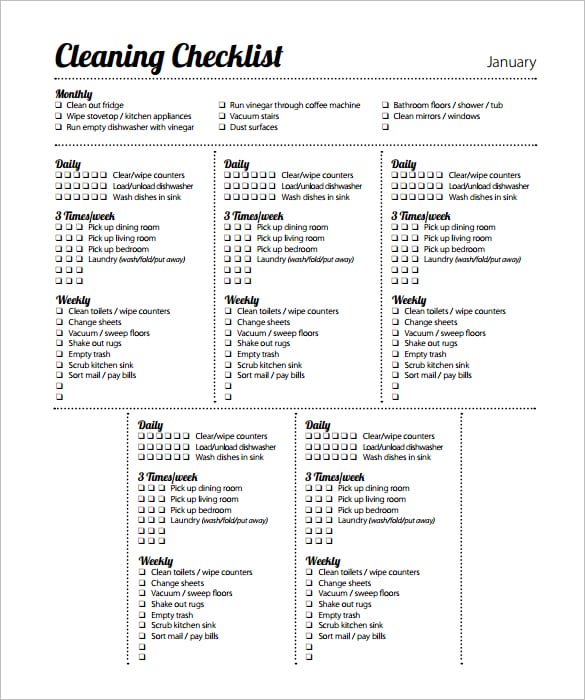
The original gallery caption identifying an editable checklist points to a PDF also linked elsewhere in the collection. Inspect its actual features before assuming editability. The label does not establish that the document can be changed in Word or that it contains interactive controls.
For an adopted file, check the text size, task spacing, room labels, status area, and references to supporting instructions. A crowded list can make exception notes difficult to read. A narrower scope can produce a more useful working page than a dense list of unrelated tasks.
Keep one current master
Separate the reusable master from completed records. Remove actual names, dates, completion marks, and exception notes before issuing a blank copy. Preserve the task labels and approved references appropriate to the next session.
When a surface, area, assignment, or procedure changes, review the affected master entries. A layout suited to a previous room may need revision. Identify the current version where users might otherwise follow conflicting copies.
Keep the task owner and the master owner distinguishable when their roles differ. One person may perform the work while another maintains the approved list. A completion note should not silently become a change to the instructions everyone follows.
Close the session and follow up
Review unresolved entries at the end of the session and assign the appropriate next action. A reported maintenance issue may remain open even when the cleaning work is complete. Keep the records connected by references without treating the end of one process as completion of another.
If the list is used repeatedly, review recurring exceptions to understand whether the task wording, resource, timing, or assignment needs improvement. A frequent unresolved item is a reason to examine the process, not simply to remove the item so the record appears complete.
Use the list to organize work and communication. It cannot establish a universal cleaning standard or replace the instructions and decisions needed for the actual setting. The value comes from clear scope, appropriate users, traceable instructions, and accurate records of what happened.
Detailed Cleaning List Template

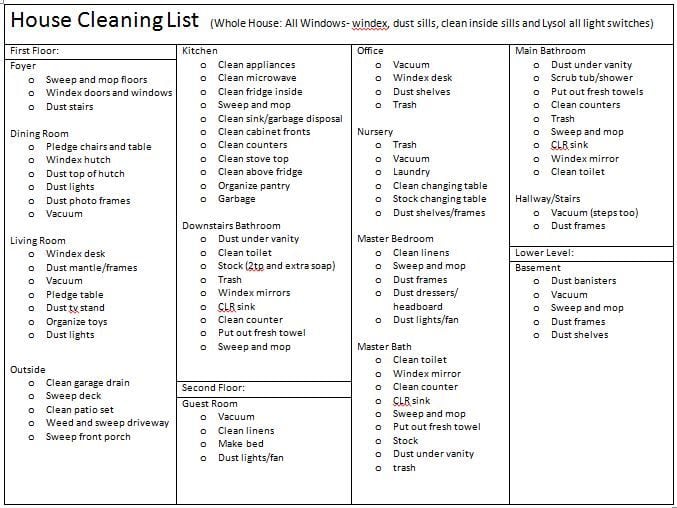
House Cleaning List Sample
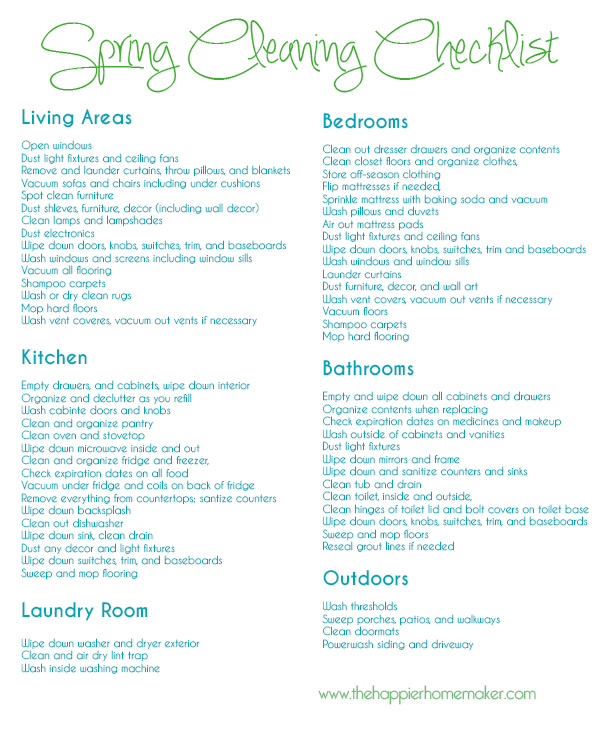
Cleaning List For Spring Cleaning
Daily Cleaning List
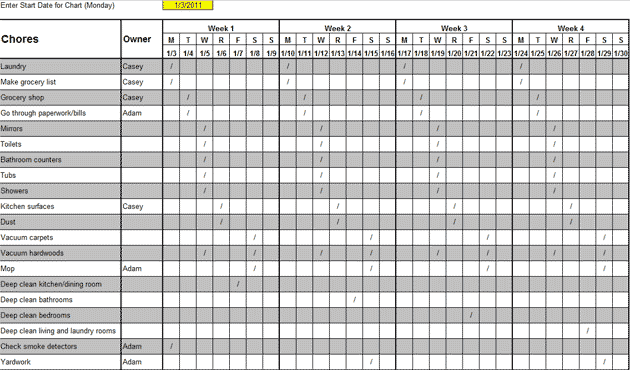
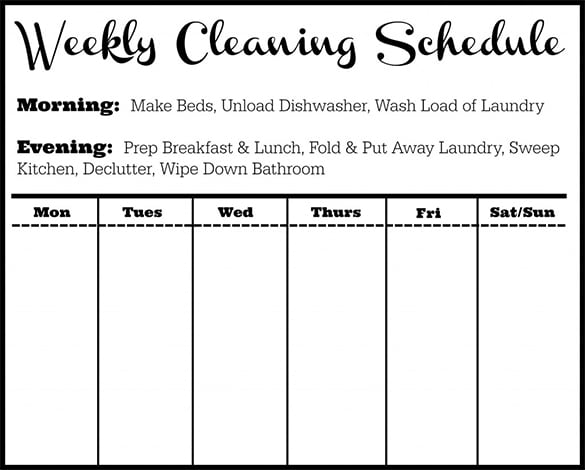
Weekly Cleaning Schedule Example
Cleaning Checklist Editable
Frequently Asked Questions
Are these six distinct editable files?
No. The resources include PDFs, external pages, and an XLS-named route, with two previews linked to the same PDF. Review the chosen resource individually.
Is this a recurring household routine?
This overview focuses on the structure of a defined session or area. A house-cleaning routine organizes recurring household responsibilities over time.
Should repairs be included as cleaning tasks?
Keep maintenance or specialist work in its appropriate process. The list can reference an observation without claiming the repair was authorized or completed.
Can a household sample become a healthcare procedure?
No. Specialist settings need their own approved requirements and trained users. A generic layout does not establish those instructions.
Where should product instructions come from?
Use the actual product label, surface instructions, and approved process. Do not invent mixtures or universal methods from a checklist.
What if an instruction is missing?
Keep the task visibly unresolved and identify the person or route responsible for clarification. Do not tick it as complete merely to finish the sheet.
Does a tick establish every condition in the area?
No. It records reported task completion. A required review or specialist assessment needs its actual process and evidence.
What should a new blank copy contain?
Keep the relevant labels and current approved references, while removing previous dates, names, completion marks, and exception notes.
