A board meeting agenda identifies the business to be considered, its order and the outcome needed from each item. Distinguish information, discussion and decisions, and identify supporting papers. This helps members prepare and gives the chair a clear basis for managing time.
Use a daily schedule to test the timing, the proxy template guide when an authorized representation arrangement needs review and a table of contents for a lengthy meeting pack. An agenda organizes business; it does not replace minutes or applicable meeting rules.
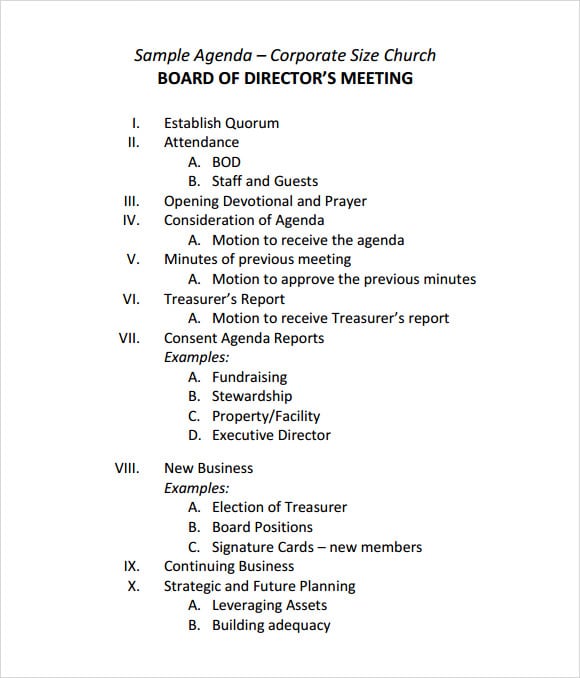
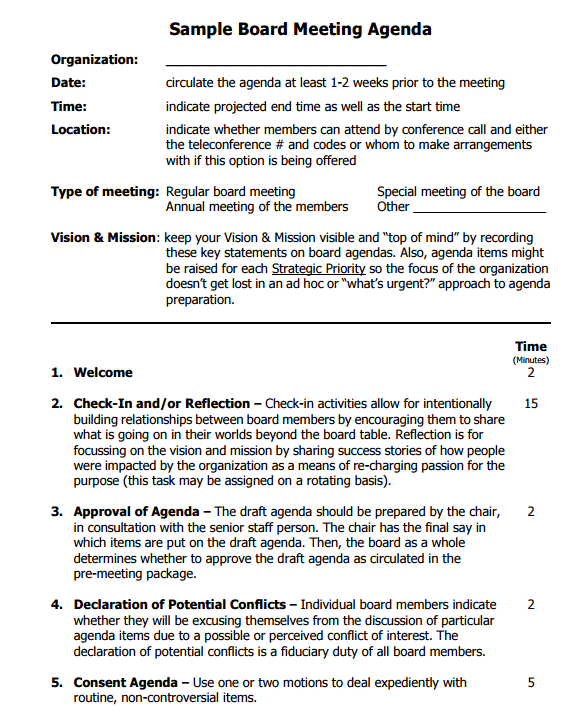
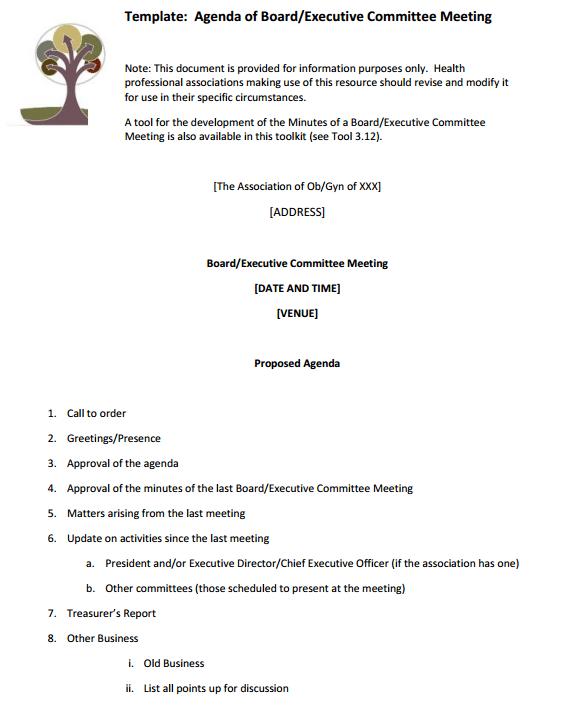
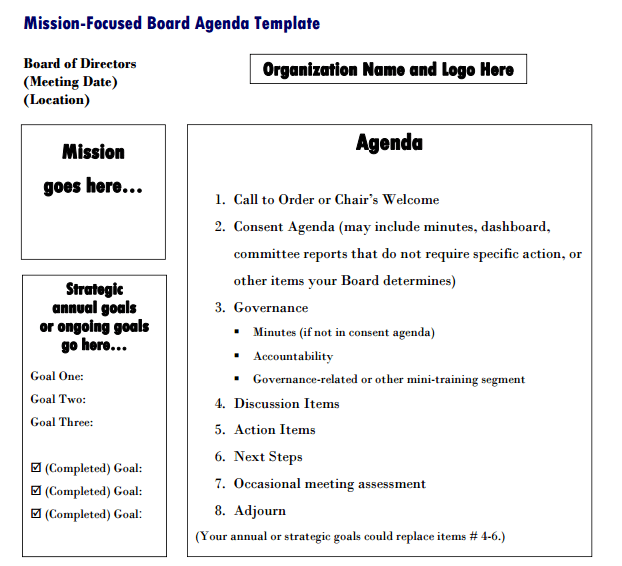
The four previews below provide different starting layouts. Two have external resource links, including a PDF agenda resource; two display download graphics without attached destinations. Check the available resource before assuming that every preview is an editable Word file. Choose the layout that fits your board’s actual meeting process.
Use these templates as planning aids for a company, association, or nonprofit board. The required notice, quorum, voting, confidentiality, and recordkeeping arrangements depend on the organization’s governing documents and applicable rules. A sample agenda does not establish those requirements or authorize a decision by itself.
Build the agenda around the meeting’s purpose
Start with the matters the board needs to address now. Separate routine updates from strategic questions and time-sensitive decisions. A list copied unchanged from the previous meeting can look complete while omitting the issue that requires the most attention.
Ask the chair and relevant staff or committee leads to identify the expected outcome for each item. “Discuss premises options” is a topic. “Agree which premises options should proceed to cost review” states the intended result. That distinction helps members prepare the right questions.
Avoid placing operational detail on the agenda merely because it is available. Some information belongs in a written report or in the responsibilities of management. Keep the board’s discussion aligned with its role and the organization’s established governance process.
Check whether an item needs further preparation before it is ready for a decision. If the cost estimate or background paper is missing, identify the gap rather than scheduling an approval that members cannot assess responsibly.
Essential agenda fields
Identify the organization, meeting type, date, start time, and location or joining arrangements. If participants are in different regions, specify the time zone. Provide a contact for access problems through the normal communication channel.
List the chair and, where useful, the person presenting each item. Use names or roles consistently. Include an estimated duration for substantial items so the total meeting length is realistic.
For each main item, show its purpose: information, discussion, or decision. Add a reference to the supporting paper or report. A document identifier can be more useful than a long title when the meeting pack contains several similarly named files.
Include the expected end time and the next meeting arrangements if known. Leave room for closing actions and any required procedural steps. Do not fill the whole available time with substantive items and assume administration will take no time.
Keep confidential access details out of a version intended for public distribution. If your organization publishes agendas, prepare the appropriate public and restricted versions under its process rather than posting private links and sensitive supporting material indiscriminately.
A sample 60-minute planning agenda
For illustration, imagine a small organization’s board reviewing a premises project. The agenda might reserve five minutes for opening procedures and approval of the previous record, ten minutes for routine reports, twenty minutes for the premises decision, fifteen minutes for a financial update, five minutes for action review, and five minutes for closing arrangements.
The premises item would identify the presenter, refer to the options paper, and state the decision sought. If the board is only choosing which options to investigate, the item should not imply approval of a lease or purchase. The supporting paper should match that narrower decision.
The financial update would distinguish figures presented for information from any approval request. If the board needs to consider a revised budget, identify it explicitly. A heading such as “finance” does not tell members whether they need to prepare to vote.
The action review would identify overdue or unresolved matters and clarify the next step. It should not become a second presentation of every earlier discussion. Closing arrangements would confirm the next meeting and any communication required after decisions.
This is a fictional allocation of time, not a universal agenda or governance rule. Adjust the items, sequence, and durations to the board’s needs and requirements. If a major decision needs more discussion, reduce other items or schedule additional time rather than disguising the problem with an unrealistic timetable.
Routine items and consent agendas
Some boards use a consent agenda to group routine matters that do not need individual discussion. This can free meeting time for issues requiring deliberation, but it depends on members receiving and reviewing the material beforehand and on the board’s agreed procedures.
BoardSource’s meeting guidance describes consent agendas as a way to group routine items and recommends reserving meeting time for substantive discussion. That guidance is particularly relevant to nonprofit boards. It does not mean that every item described as routine should be approved without appropriate review.
Identify the included documents clearly and follow the process for removing an item when discussion is needed. Do not use a consent agenda to conceal a new, controversial, or insufficiently explained decision. The label should describe the nature of the business, not suppress questions.
If your board does not use that approach, keep routine items concise and properly supported in the ordinary agenda. The template should fit the actual procedure rather than introducing a governance practice simply because it appears in a sample.
Prepare the supporting papers
The agenda tells members what will be considered; the meeting pack gives them the information needed to consider it. Keep document titles and references consistent between the two. A missing or mislabeled paper can make a carefully planned agenda difficult to use.
For a decision paper, explain the question, relevant options, material implications, and the recommendation where appropriate. Distinguish established facts from estimates or assumptions. Identify the approval sought precisely so members understand what a decision would authorize.
Circulate material under the board’s agreed timetable and access process. Do not claim that a generic number of days satisfies every notice requirement. Check the governing documents and relevant rules when timing or meeting procedure matters.
If late material is unavoidable, make the change visible and explain how it affects preparation. Do not silently replace a paper after members have reviewed it. Keep an identifiable version of the agenda and supporting documents used for the meeting.
Sequence the discussion thoughtfully
Place important, time-sensitive items where the board can give them adequate attention. An agenda that leaves a complex decision to the final few minutes may encourage rushed consideration or a deferred outcome.
Group related items when that helps the reasoning. For example, an options review may need to precede a budget discussion. Identify dependencies so the chair understands what can still proceed if an earlier item is deferred.
Allow room for questions without treating estimated durations as inflexible promises. Time estimates guide the meeting; they should not prevent members from addressing a material concern. The chair can manage the discussion under the board’s procedure and adjust the plan when needed.
“Any other business” should not become a substitute for proper preparation of significant decisions. Handle new matters according to the organization’s rules, including any notice or scope requirements. A blank line on a template is not authority to decide every issue raised.
Capture attendance, decisions, and actions separately
An agenda is a plan, while minutes record the meeting under the organization’s process. Do not overwrite the agenda with an informal summary and assume that it becomes an adequate official record. Keep each document’s purpose clear.
A sign-in sheet template may help record attendance where suitable, but it does not by itself establish quorum or voting eligibility. Those questions depend on the board’s governing arrangements and the actual attendance record. Protect contact details if they are collected.
After the meeting, translate agreed follow-up into specific actions with an owner and due date. A task list template can support a simple action register. Link each action to the relevant decision or discussion reference so its purpose remains understandable.
For a larger initiative, an action plan template can help arrange several related steps, responsibilities, and review points. Keep the plan aligned with what the board actually authorized rather than expanding the scope through the wording of follow-up tasks.
Adapt the resource without losing useful structure
Select a preview with enough space for item purpose, presenter, time, and paper reference. A compact agenda may suit a short routine meeting. A more detailed layout may be better when several decisions require supporting papers and clear outcomes.
Replace sample organization names, dates, locations, and item labels. Remove irrelevant procedural headings only after checking the board’s requirements. A heading that looks unnecessary to a new editor may serve an established governance purpose.
Use a consistent numbering system and make page breaks sensible. Members should be able to refer to an item without describing its position on a page. If the agenda spans several pages, include a clear meeting identifier and page numbering in the finished document.
Before circulation, compare the agenda with the meeting pack and confirm that each decision item is ready. Check access instructions, document references, and the total planned duration. The quality of preparation matters more than decorative formatting.
Review the agenda process after the meeting
Note which items took substantially more or less time than expected and why. A recurring overrun may indicate that the topic needs a different paper, a clearer decision request, or more time. It does not automatically mean that discussion was inefficient.
Ask whether members had the information needed and whether the final actions were clear. Use that feedback to improve the next agenda. Keep useful recurring items, but review them rather than treating a template as a permanent instruction.
A well-prepared board agenda supports informed consideration and a usable record of follow-up. It cannot guarantee a successful meeting, replace the board’s judgment, or establish compliance on its own.
Board Agenda Templates Are Added Here

Board agenda questions
How is an agenda different from minutes?
An agenda plans the business to be considered. Minutes record the meeting and decisions under the organization’s procedures. Keep the documents distinct and use the required recording process.
Should every agenda item have an estimated time?
Time estimates help for substantial items and overall planning. Use them realistically and allow the chair to manage material discussion under the board’s procedure.
What is a consent agenda?
It groups routine matters for consideration together under an agreed process. Members need the relevant material beforehand, and items needing discussion should be handled appropriately.
Can any other business include a major new decision?
Check the governing documents and applicable rules. A template heading does not remove notice, authority, or procedural requirements for a significant decision.
Do these previews all include editable files?
No such claim is established by the gallery. Two previews have external resource links, while two download graphics have no destination. Check the actual resource format.
What should happen to follow-up tasks?
Record an owner, next step, and due date where appropriate, and connect the action to the meeting reference. Review unresolved actions through the board’s normal process.