
A work recommendation letter connects a person’s relevant abilities with the writer’s direct observations. Explain the working relationship and choose examples that address the recipient’s needs. A credible recommendation states what the writer knows rather than repeating a resume or guaranteeing future performance.
Use a letter of appreciation for simple thanks, review offer letter samples for the later hiring stage and use interview follow-up emails for candidate correspondence. Keep endorsement, recruitment communication and an employment offer clearly distinguished.
The previews below show sample layouts; use the download button under each preview that offers a file. Check that the actual example fits an employment application before adapting it. A research or academic recommendation may emphasize different evidence from a workplace letter, and a PDF sample is not necessarily an editable Word document.
This guide is for supervisors, colleagues, or other people who can provide an honest account of relevant work. The applicant may supply background information, but the recommender should make their own assessment and approve the final wording. A letter should not claim firsthand knowledge the writer does not have.
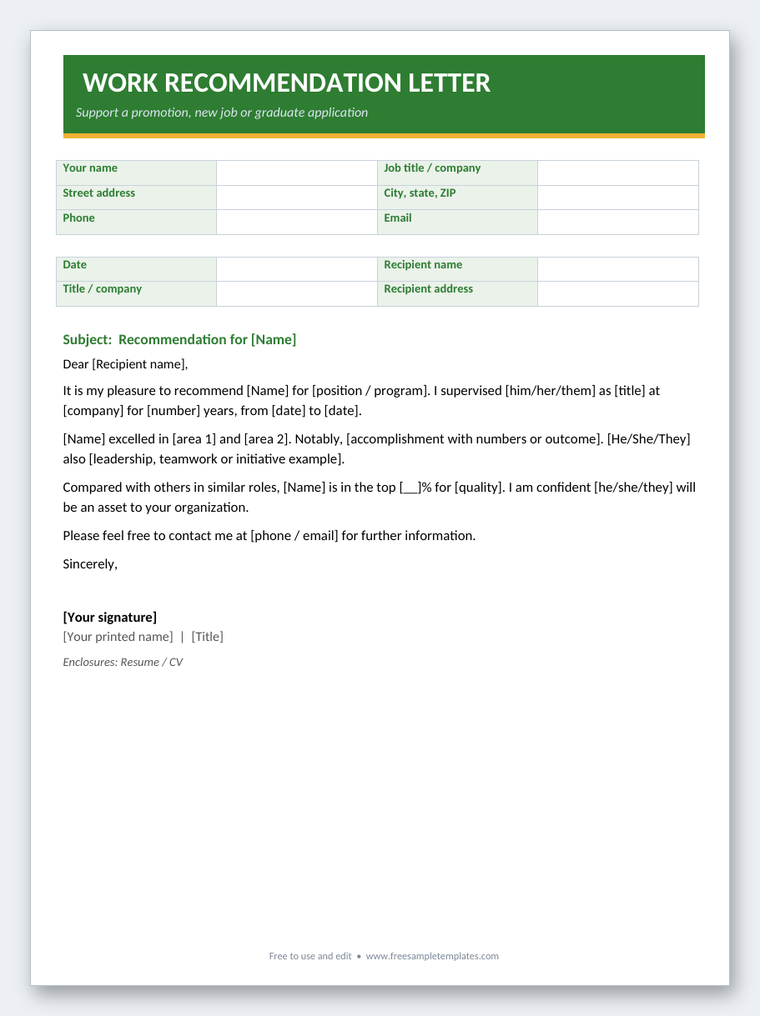
Free Work Recommendation Letter (Word Template)
Download this ready-to-use, fully editable work recommendation letter in Microsoft Word (.docx) format. Fill in the fields, adjust the layout to your needs, then print or save it.

Confirm the request before agreeing
Ask what role the person is applying for, who will receive the letter, and how it must be submitted. A general letter addressed “To whom it may concern” may be acceptable in some situations, while a specific employer may request direct submission or a particular form.
Check the deadline and any instructions about confidentiality, length, or contact details. Do not promise a letter you cannot complete thoughtfully in time. If your organization restricts references to an authorized department, follow that policy rather than using business letterhead to imply approval you do not have.
Consider whether you know the person’s work well enough to recommend them. You can be supportive without inventing evidence. If your contact was limited, explain the scope accurately or decline the request where appropriate.
Ask the applicant for the job description, current résumé, and reminders of relevant projects. Use that information to locate examples you actually observed. Verify dates, titles, and achievements before including them.
Identify the relationship and its limits
The opening should say who you are, how you know the applicant, and the period or setting of your work together. “I supervised Morgan Lee on the customer-support team from March 2023 to August 2025” gives the reader a basis for evaluating the recommendation.
A colleague can explain that they worked alongside the applicant rather than describing themselves as a supervisor. A project lead can identify the project and responsibilities they observed. Do not enlarge your role to make the letter sound more authoritative.
Distinguish observed performance from information supplied by the applicant. If a qualification is relevant but you have not verified it, avoid presenting it as your own confirmed finding. The letter need not list every educational detail; the application can provide that information through the appropriate channel.
If you are writing in a personal capacity, make that clear when necessary. Use organizational branding only when permitted. A letterhead template can help arrange a professional document, but the design does not confer authority to speak for an employer.
Choose evidence that matches the role
Read the role requirements and select two or three relevant strengths. For a coordination role, useful evidence might concern planning, communication, and dependable follow-through. For a technical role, the evidence may concern problem analysis, accuracy, and collaboration within the writer’s knowledge.
Describe an example with a situation, the person’s action, and a relevant outcome. “She maintained the team’s shared issue tracker and followed up on unresolved requests each week” is more informative than “She is extremely organized.” The example explains what the skill looked like in practice.
Use numbers only when accurate and appropriate to disclose. Do not invent a percentage improvement because quantified statements seem persuasive. A clear qualitative example is better than a fabricated metric.
Avoid confidential client details, private employee information, and proprietary project data. You can often describe the work at a useful level without naming a customer or revealing internal figures. Check permission before sharing information that belongs to the organization.
A complete fictional example
The following sample concerns a fictional applicant and workplace. It illustrates the structure and does not certify any real person’s performance.
“Dear Hiring Manager,
I am pleased to recommend Morgan Lee for the office coordinator role. I supervised Morgan at Cedar Lane Services from March 2023 to August 2025, when Morgan worked as an administrative assistant supporting our small operations team.
Morgan managed the shared appointment calendar, prepared routine meeting materials, and maintained our follow-up register. During a period when the team changed its appointment process, Morgan checked the new records against existing bookings and raised discrepancies before revised confirmations were sent.
I particularly valued Morgan’s clear communication. When a request could not be completed immediately, Morgan recorded the next step, identified who needed to respond, and kept the relevant colleague informed. This helped the team distinguish completed tasks from items still awaiting action.
Based on the work I observed, I believe Morgan’s organization and careful follow-through would be relevant to an office coordination role. I would be happy to discuss that experience through the contact details provided.
Yours sincerely, Taylor Reed Operations Supervisor”
The sample identifies the relationship, gives two connected examples, and states a proportionate recommendation. It does not promise that the applicant will succeed in every setting or claim knowledge of abilities the writer has not observed.
For a real letter, replace the fictional details with verified information and match the examples to the actual role. Do not keep the project description simply because it sounds convincing.
Distinguish a recommendation from other documents
A recommendation supports an assessment of suitability. An employment verification letter may confirm limited facts such as role and dates under the employer’s policy. Do not turn a verification request into an unsolicited evaluative letter.
An internal referral is another process. A employee referral form template may help an employee submit a candidate through a company’s referral route. The referral form and the recommendation letter can complement each other, but neither guarantees an interview or job offer.
A business reference letter template concerns a business relationship or organization rather than necessarily an individual employee’s performance. Choose that format when the reader needs information about a supplier or business partner. Keep the employment recommendation focused on the person’s relevant work.
An academic recommender may discuss coursework or research they supervised. They should identify that setting honestly rather than pretending to have managed the person in employment. The recipient can then assess how the evidence relates to the role.
Keep the wording fair and accurate
Use measured language. “I found Morgan reliable in maintaining our follow-up records” states the writer’s experience. “Morgan will never make a mistake” is an unrealistic guarantee that no recommender can support.
Avoid unnecessary comparisons with other employees. A recommendation can explain strengths without disclosing a colleague’s performance or describing everyone else as inferior. If a comparative statement is genuinely appropriate, ensure that its basis is clear and accurate.
Focus on relevant work rather than personal characteristics unrelated to the role. Do not use the letter to speculate about health, family plans, or other private matters. In the United States, the EEOC’s employment guidance addresses discriminatory employment and referral practices; other locations have their own requirements.
A reference should also follow the applicable policy and legal requirements concerning accuracy, privacy, and employment decisions. If a difficult issue arises, seek the appropriate organizational or professional guidance rather than copying a confident statement from a generic sample.
If the applicant drafts background wording
An applicant can provide a list of projects and achievements to make preparation easier. That list is input, not the finished recommender’s assessment. Check each point before using it.
If you are asked to review a draft, rewrite any statement you cannot personally support. Confirm the relationship, examples, dates, and final recommendation. Do not sign simply because the applicant says the wording is standard.
The applicant should not submit a letter under someone else’s name without that person’s approval. A signature, letterhead, or contact detail copied from an old document does not establish consent to a new recommendation.
Keep the final approved version and the submission instructions. If a later request concerns a different role, review the wording again instead of assuming that the original letter remains suitable for every purpose.
Format and submit the letter
Use a clear font, ordinary paragraph spacing, and a readable contact block. A focused letter often fits on one page, although the recipient’s instructions take priority. Do not shrink the text excessively to preserve an unnecessary paragraph.
Check the applicant’s name, recipient, role, dates, and organization names carefully. Template reuse can leave a previous applicant’s details in the subject line or closing. Review the final exported or printed version, not just the editable file.
Follow the submission route requested by the employer or applicant. If direct confidential submission is required, send it through that process. If you provide a copy to the applicant, be clear about any limits on reuse or the purpose for which it was written.
Before sending, ask whether every substantive sentence is accurate, relevant, and within your knowledge. A restrained letter with concrete evidence can be more credible than several pages of exaggerated praise.
Work recommendation letter questions
Can a colleague write a recommendation?
Yes, when the recipient accepts it and the colleague can describe relevant work honestly. Identify the relationship accurately instead of implying that the writer was a supervisor.
What if I do not know the applicant’s work well?
Explain the limited setting you observed or decline the request where appropriate. Do not invent examples or claim knowledge supplied only by the applicant.
Should I include a résumé in the letter?
Use relevant résumé information to prepare, but do not reproduce the whole document. The recommendation should add the writer’s perspective and evidence.
Can the applicant write the final letter for me?
They can provide background or a draft, but the recommender must verify, approve, and own the assessment. The applicant must not submit it under another person’s name without approval.
Does a recommendation guarantee a job?
No. It is one source of information for the recipient’s decision. Avoid promises about hiring or performance in circumstances the writer cannot assess.
Are these all editable employment-letter files?
The resources are external and several are PDFs, including academic-hosted material. Check the actual contents, format, and relevance to the employment request before adapting a sample.
