Contract agreement samples help parties organize the proposed work, responsibilities, payment events and relevant terms. Identify the parties and actual arrangement, then review the wording for that purpose. A sample provides structure rather than assurance that its provisions suit every transaction.
Define project outputs in a statement of work, document selected services in a service order and trace payments in a payment history record. Keep administrative records aligned with the reviewed agreement without treating them as a substitute for agreed terms.
This page now includes two original downloads: Project Services Agreement Worksheet and Ongoing Services Terms Worksheet. Choose the Project Services Agreement Worksheet for a defined deliverable-based engagement. Choose the Ongoing Services Terms Worksheet for recurring periods, fee arrangements, responsibilities, and transition terms.
The new files appear first with previews and clearly labeled download buttons. The original gallery and its resource examples follow the practical guide; descriptions of the older collection refer to that original gallery. The new PDFs have fillable fields; save a local copy, open it in a compatible PDF viewer, and review the saved result before printing or sharing.
A purchase order records a buyer’s ordering information, a deal memo summarizes a production engagement, and the loan agreement guide covers a lending context. This overview explains general document organization while those specific transactions need their own applicable terms and requirements.
Two new templates to download
Choose the Project Services Agreement Worksheet for a defined deliverable-based engagement. Choose the Ongoing Services Terms Worksheet for recurring periods, fee arrangements, responsibilities, and transition terms.
Project Services Agreement Worksheet
Draft the commercial terms of a defined project for appropriate review.
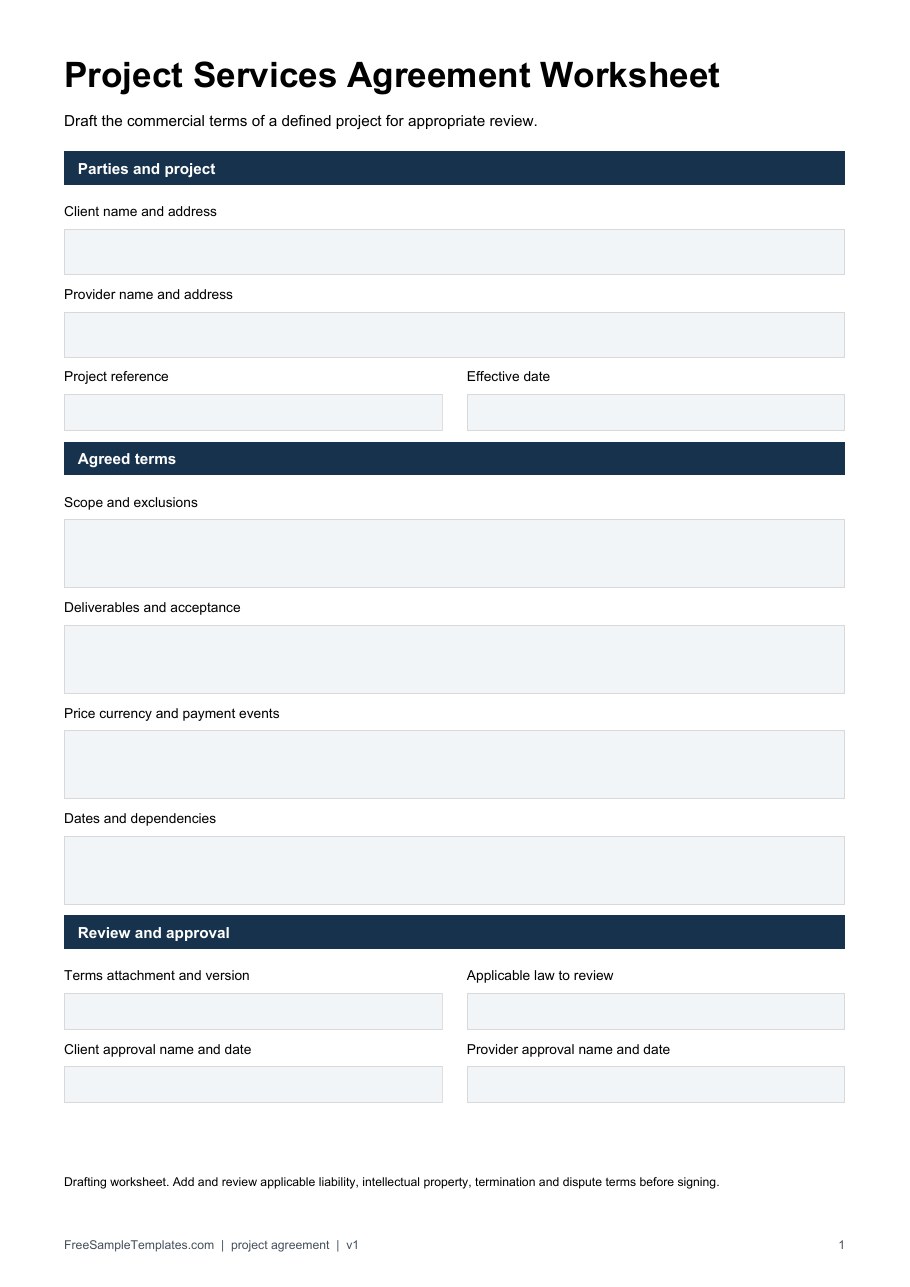
Download Project Services Agreement Worksheet (PDF)
Ongoing Services Terms Worksheet
Organize recurring service periods, fees, responsibilities and exit arrangements.
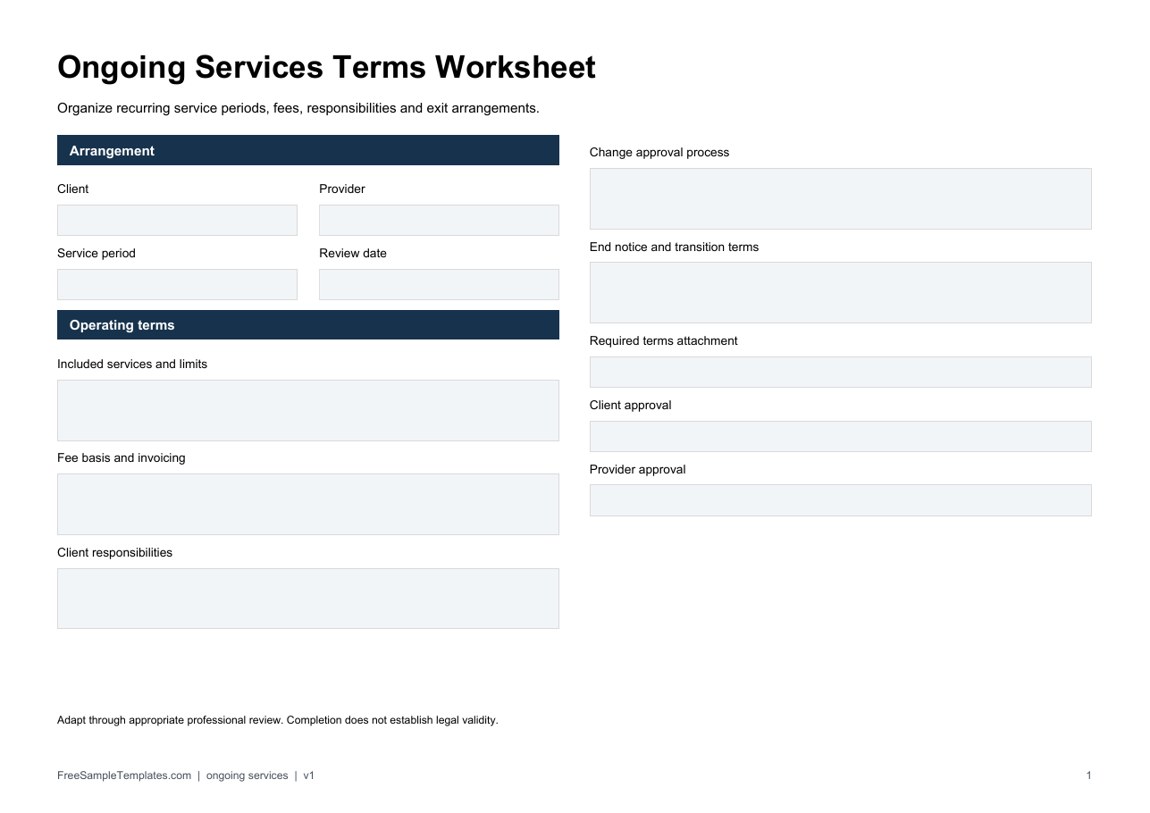
Download Ongoing Services Terms Worksheet (PDF)
How to use the new downloads
Complete the commercial facts before considering legal clauses: identify the actual parties, describe included and excluded work, define payment events, and record dates and dependencies. Connect the worksheet to the relevant terms attachment and its version. The approval fields should identify the actual reviewing and approving people.
For a fictional fixed project, a price of 600 split into an initial 200 and a delivery payment of 400 can be described as two separate payment events. For ongoing services, define the billing period and which services the recurring fee covers. Review applicable liability, intellectual property, termination, and dispute terms; these drafting worksheets do not establish enforceability.
Identify the agreement’s actual purpose
Start by stating what the parties intend to do. A service engagement, sale, employment relationship, rental, and lending arrangement have different needs. A broad heading saying agreement between two parties is not enough to explain the transaction.
Describe the business or personal context clearly and identify the jurisdiction where appropriate through qualified review. The sample should be selected for its actual relevance rather than the apparent formality of its layout. A document suited to another context can contain misleading provisions.
Keep a proposal or discussion draft distinguishable from a final agreement. Drafting a document does not establish that the parties have agreed to every term. Identify unresolved issues through the review process instead of filling them with invented assumptions.
Use the correct parties and authority
Record the actual person or legal entity entering the arrangement. A trading name, project name, and individual contact can serve different functions. Make their roles clear rather than relying on a logo to identify who has obligations.
Identify the appropriate contact and signing role through the real process. A person discussing the work may not have authority to bind an organization. A signature field in a template does not establish that authority.
Check names and relevant references against the appropriate sources. A spelling error or outdated entity detail can create confusion about which party is intended. The document needs the actual participants, not sample names retained from an earlier transaction.
Describe scope and responsibilities precisely
State the goods, services, work, or other subject of the agreement. Use clear descriptions and identify supporting specifications where the detail is extensive. A general phrase such as all necessary work can leave important boundaries uncertain.
Separate what each party is responsible for. One may supply information or access while another performs the work. A useful agreement identifies the dependency rather than assuming every action belongs to the service provider.
Define exclusions where they are relevant and agreed. A clear scope can explain what the transaction covers without implying unlimited additional services. The document should represent the actual arrangement rather than promise every outcome someone might later request.
Connect deliverables, dates, and review
Distinguish a target date from an agreed obligation and identify the relevant event. A start date, delivery date, review period, and payment date have different roles. A single date field should not silently stand for all of them.
If acceptance or review is part of the arrangement, explain the actual process and relevant criteria through appropriate drafting. Delivery and acceptance can be separate events. A completed task should not automatically be described as accepted when a required review remains.
Identify what happens when a dependency changes through the agreed process. Delayed information or a changed scope can affect timing, but the appropriate response depends on the actual terms. Do not assume a generic sample authorizes unilateral changes.
Make the payment arrangement understandable
Write the price or compensation basis, relevant currency, and the actual payment events. A fixed price, hourly rate, staged payment, and reimbursable expense arrangement differ. The terms should explain the unit and scope of each amount.
Identify relevant additional charges or adjustments accurately. A blank field does not establish that taxes, expenses, or another charge are included or zero. Use the applicable rules and agreement rather than inventing figures to complete the page.
Keep invoices, receipts, and payment status distinguishable from the agreement itself. An agreed amount is not proof that it has been paid. A signed contract does not automatically settle every later payment question.
Fictional example: a defined design service
Imagine an invented designer and client agreeing on a specified set of three layout concepts and one selected final design. The document identifies the required inputs, delivery dates, review steps, and the actual payment arrangement. It does not imply an unlimited number of revisions.
The simplified price is six hundred units of currency, with two hundred paid as an agreed initial amount and four hundred remaining under the example’s arrangement. The agreement describes the terms while a separate receipt records the actual initial payment.
The client later asks for another design format outside the stated scope. The parties use their real change process to decide the additional work and any effect on timing or price. The sample’s broad service heading is not treated as automatic approval for that extra work.
These details illustrate structure and arithmetic only. They are not contract clauses or a valuation benchmark. A real engagement needs appropriate review of its actual scope, rights, terms, and applicable requirements.
Treat legal provisions as substantive content
Liability, indemnity, confidentiality, intellectual property, termination, and dispute provisions can have important consequences. Do not copy them simply because they make a document appear complete. Their suitability depends on the real transaction and applicable law.
Australian business.gov.au guidance on preparing a contract discusses identifying the parties, the work, payment, and relevant responsibilities. It provides one jurisdiction’s guidance while your actual arrangement may need different requirements and qualified review.
A sample does not guarantee enforcement, prevent every dispute, or protect both parties equally in every circumstance. The effect depends on the document and facts. Use appropriate legal assistance where the transaction or uncertainty calls for it.
Review subject-specific requirements
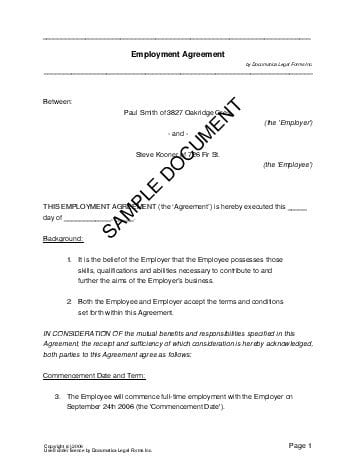
An employment example is not a universal contractor agreement, and a Nigeria employment resource has a specific jurisdictional context. A rental, loan, sale, or regulated transaction can need terms and documents beyond this general overview.
Do not assume that renaming a form changes the legal character of the relationship. The actual arrangement and applicable rules matter. A document title should describe the purpose accurately rather than be used to bypass the relevant requirements.
Where a required form or process applies, use it through the appropriate route. A generic sample can help organize questions, but it cannot replace a mandated disclosure, authorization, or registration step merely by looking official.
Resolve inconsistencies and open issues
Read the agreement as a whole, including referenced attachments. A scope paragraph, price table, and schedule can contradict one another even when each section looks clear alone. Identify and resolve differences before treating the document as final.
Check that references point to the correct version of a supporting specification or policy. An unspecified attachment can leave the parties relying on different documents. Clear references help preserve the actual agreed context.
Do not complete unknown fields with guesses. Mark issues for review and use the actual decision process. A document with unresolved material terms should not appear executed simply because every cell contains text.
Handle changes and execution through the real process
Use an agreed method for changes and identify the revised terms. Keep the relationship between the current version and prior drafts clear. A revised file name alone may not explain which obligations were changed or whether the parties accepted them.
Follow the applicable requirements for signing and any other formalities. A generic signature block does not decide whether electronic signatures, witnesses, notarization, or other steps are appropriate or required for the actual arrangement.
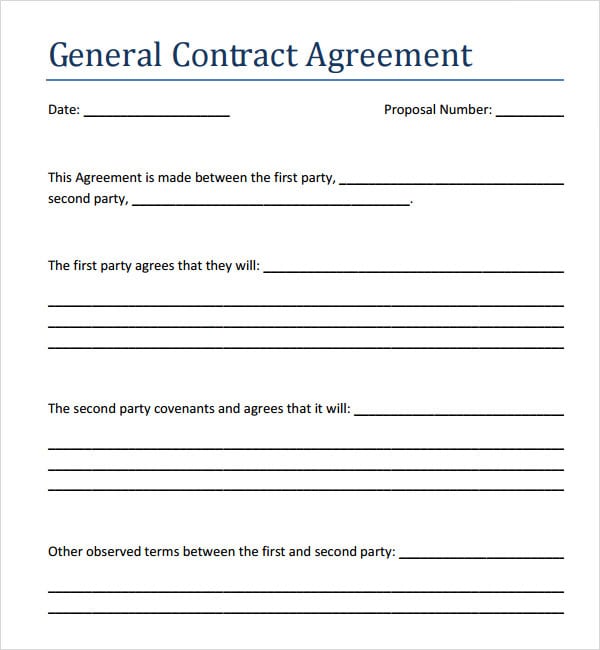
Keep the completed record and relevant supporting documents distinguishable from a blank master. Remove actual names, prices, dates, and signatures before reusing the layout. Demonstration copies should not be mistaken for an active agreement.
Inspect the external resources carefully
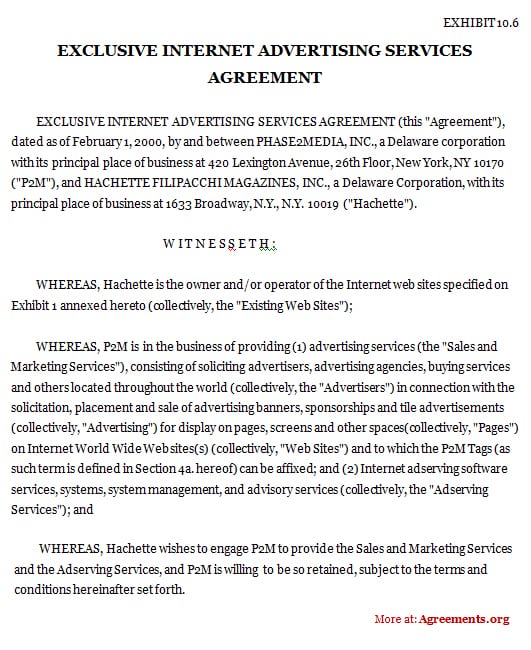
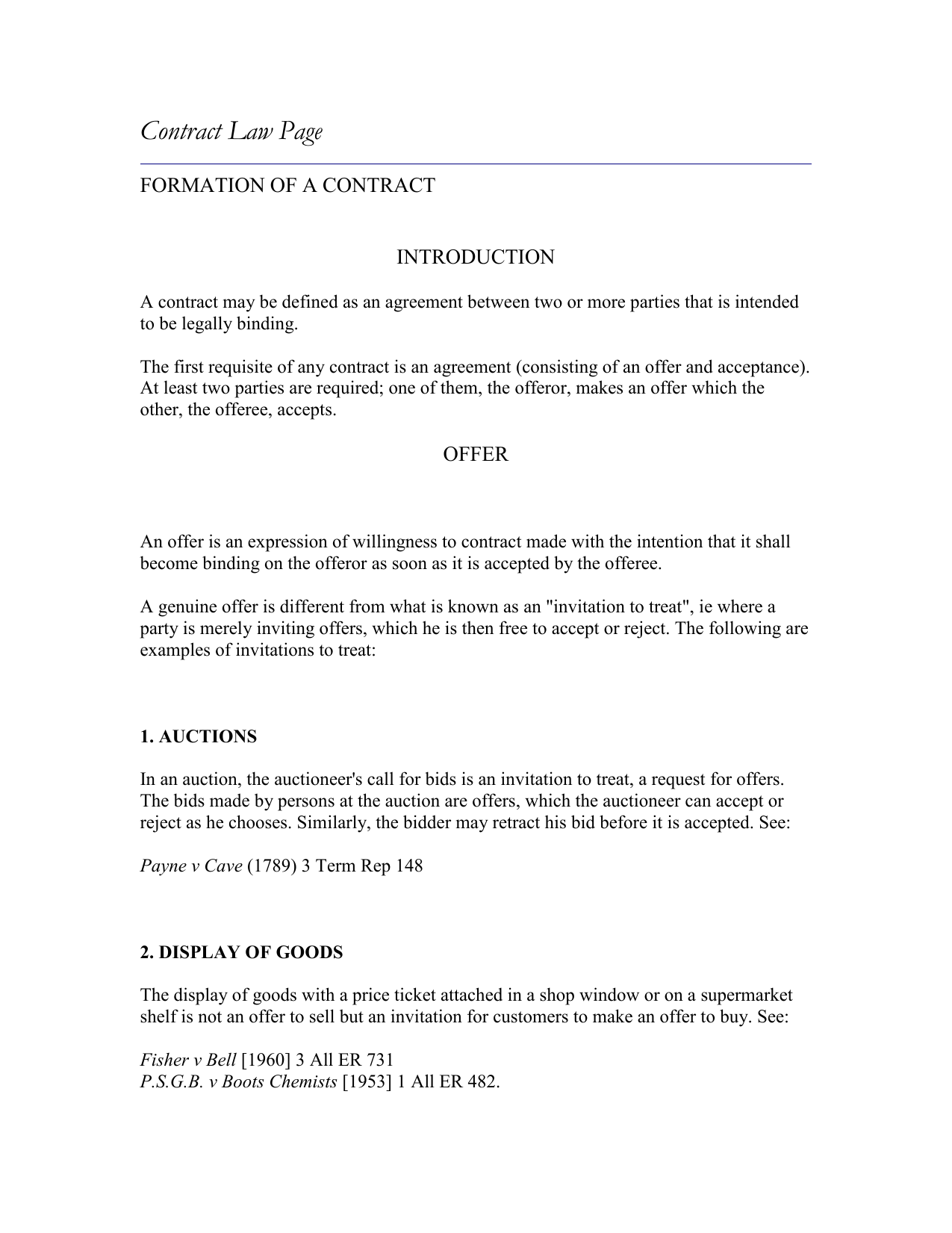
An external product page, document generator, study page, or example collection can supply different things. Review the actual resource and its conditions rather than assuming every preview offers a ready-to-use file. Availability and suitability are separate questions.
Check any prefilled clauses and jurisdiction references as carefully as the editable fields. A neat design may contain terms that do not fit your transaction. Appropriate content review should precede relying on the finished formatting.
A useful agreement sample organizes the issues and supports accurate drafting. It does not create universal legal certainty. Clear purpose, correct parties, precise scope, honest figures, appropriate review, and a traceable final version give the document practical value.
Contract Agreement Between Two Parties Samples Are Here

Frequently Asked Questions
Does a sample guarantee an enforceable contract?
No. The effect depends on the actual terms, facts, authority, formalities, and applicable law.
What formats are the two new downloads?
The two new files are fillable PDFs with different purposes and matching previews. Open them in a compatible PDF viewer, complete the fields and save your copy. They are not DOCX files, and numerical PDF fields do not calculate totals automatically. The original gallery has its own mixed resources and formats.
Can I rename an employment form as a service agreement?
A title does not decide the actual legal relationship. Use a document and review process suited to the real arrangement.
What should the scope section explain?
Identify the actual goods, services, responsibilities, deliverables, relevant dependencies, and agreed boundaries.
Is an agreed price proof of payment?
No. The agreement records terms, while invoices, receipts, and payment records describe later events.
Should legal clauses be copied unchanged?
Review them for the actual transaction through an appropriate qualified process. A sample does not establish suitability.
How should an extra service be handled?
Use the actual change process to decide scope, timing, and compensation. Do not assume the original heading authorizes unlimited additions.
What should be cleared from the blank master?
Remove actual party details, prices, dates, signatures, and transaction-specific decisions while retaining the appropriate reviewed structure.