
A charitable donation receipt template helps an organization acknowledge a contribution actually received. Identify the real recipient, gift date and description, and distinguish the acknowledgment from an earlier pledge. Use wording appropriate to the gift and applicable requirements rather than assuming a generic form establishes deductibility.
Connect the receipt to the donation form, maintain approved donor communication routes in a contact list and consult the auction guide when a payment relates to an auction purchase. A gift acknowledgment and an auction sale record may require different descriptions.
The previews below show sample layouts; use the download button under each preview that offers a file. All four previews have links. Check the actual resource for its format and use terms before assuming that each image supplies a free editable file.
A receipt does not by itself make a gift tax-deductible or establish that an organization is a qualified charity. Rules vary by country and donation type. This guide separates practical recordkeeping from selected United States substantiation requirements, which should be checked against current IRS guidance and the donor’s circumstances.
Free Donation Receipt (Word Template)
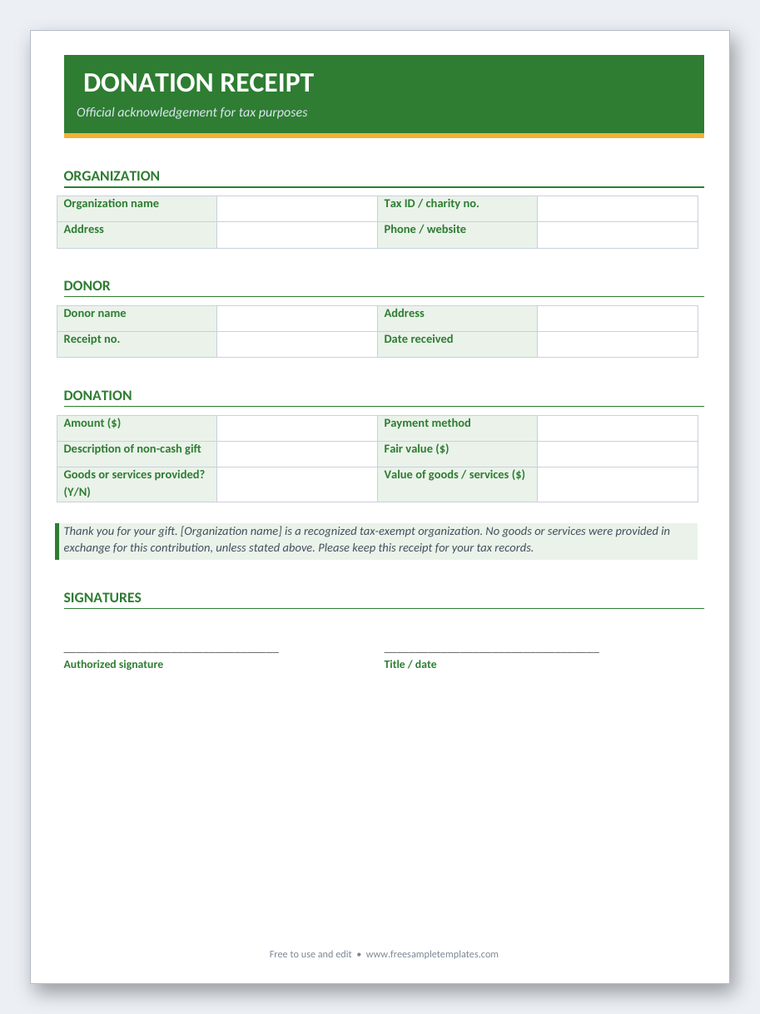
Download this ready-to-use, fully editable donation receipt in Microsoft Word (.docx) format. Fill in the fields, adjust the layout to your needs, then print or save it.

Confirm the contribution before issuing the receipt
Distinguish a promised donation from a gift received. A pledge form records an intention; a receipt should not state that money or property has been received when it has not.
Check the contribution against the organization’s payment or intake record. Confirm the donor identity where needed, the date, the amount or property description, and the receiving organization. Use an appropriate reference so the acknowledgment can be traced.
A charitable donation form template can support the earlier intake or pledge process. Carry verified information into the receipt, but do not treat an incomplete form as proof that the donation was completed.
If the contribution arrives through a fundraising platform or another intermediary, confirm the actual recipient and documentation process. Avoid issuing overlapping acknowledgments that could make the donor believe there were two separate gifts.
Core information for a useful record
Show the organization’s real name and an appropriate contact method. Include a receipt reference and issue date if your process uses them. Keep the donation date distinct from the date the acknowledgment is prepared.
Identify the donor accurately without collecting unnecessary private information. A name and suitable delivery contact may be enough for the organization’s purpose, subject to applicable requirements. Do not print private identifiers simply because a sample has a blank field.
For money received, state the amount and currency. Use a payment reference where useful, but do not expose full bank or card details. Acknowledgment wording should match the payment record.
For property, describe the items clearly enough to identify the contribution. Quantity and a useful description matter more than vague wording such as “various goods.” Handle valuation and special documentation under the requirements that apply to the donation.
State any relevant goods or services provided in exchange accurately. A standard sentence saying there were none should be used only when it is true and appropriate. Do not copy it automatically into every fundraising receipt.
United States written-acknowledgment requirements
IRS guidance explains that a written acknowledgment for a contribution of $250 or more includes the organization’s name, the cash amount or a description of noncash property, and appropriate information about goods or services provided in return.
For a noncash contribution, that acknowledgment describes the property rather than stating its value. If goods or services were provided, the acknowledgment generally needs a description and a good-faith estimate of their value. Relevant exceptions and special situations, including intangible religious benefits, need the correct treatment.
These are selected requirements, not a complete determination of a deduction. Donors must also meet the applicable timing, eligibility, and other substantiation rules. Use current IRS materials for the actual donation rather than assuming the template’s layout is sufficient.
A receipt from an organization that calls itself nonprofit does not automatically establish eligibility for deductible contributions. The IRS Tax Exempt Organization Search provides information about eligibility to receive tax-deductible contributions, with the qualifications explained in official guidance.
Illustrative cash acknowledgment
For a fictional example, an organization might record: “We acknowledge receipt of a contribution of USD 300 from Jordan Lee on 12 October 2026. No goods or services were provided in exchange for this contribution.”
The organization’s actual name and appropriate contact information would also appear in the acknowledgment. The sentence about benefits is suitable only if it reflects the transaction and the relevant requirements. It is not a claim about the tax status of any real organization.
The example shows how the amount, donor, date, and benefit statement can be kept clear. It does not establish that the fictional gift is deductible or that the wording covers every circumstance.
For a genuine receipt, verify the information and use the organization’s approved acknowledgment process. Avoid adding “fully tax-deductible” unless an appropriate, accurate basis exists for that statement. A donor’s deduction can depend on more than the face of the receipt.
Noncash gifts need a description
For an illustrative property record, “Five used wooden chairs received on 12 October 2026” identifies the gift more clearly than “furniture donation.” Add other identifying detail when relevant and appropriate.
Do not casually assign the donor’s claimed tax value in the charity’s acknowledgment. Under the cited United States acknowledgment guidance, the document describes the property without stating its value. Donor valuation, appraisal, and filing requirements are separate questions.
Certain property types can involve special rules and forms. A general receipt cannot settle the treatment of a vehicle, securities, inventory, or other complex gift. Direct the donor and the organization’s staff to the appropriate current guidance or professional support.
A photograph or intake record may help the organization’s own process when appropriate, but it does not replace required documentation. Keep any supporting material secure and connected to the receipt reference.
Gifts with benefits in return
A fundraising payment may partly pay for a benefit and partly represent a contribution. A dinner, ticket, or other benefit can affect the documentation and potential deduction. Do not describe the entire payment as a pure donation without checking the arrangement.
IRS guidance has separate disclosure rules for quid pro quo contributions over $75. The threshold concerns the payment described by that rule, not simply the amount the donor hopes to deduct. Review the official guidance and relevant exceptions for the actual event.
As an illustrative calculation, a payment of 100 with a benefit valued at 40 leaves a difference of 60. That arithmetic alone does not determine the donor’s final tax position. The organization needs an accurate basis for the benefit description and value and must use the applicable disclosure process.
If no goods or services were provided, use an accurate statement to that effect where appropriate. If a benefit was provided, do not keep the “none” wording because it makes the receipt simpler.
Repeated gifts and annual summaries
An organization may acknowledge donations individually and also provide a summary. Make clear whether the summary repeats previously acknowledged gifts or documents additional contributions. Avoid presenting both as separate donations.
For repeated gifts, retain the dates and amounts needed to trace the record. A yearly total without supporting entries can be hard to check. If you consolidate acknowledgments, ensure that the necessary information and statements cover the actual gifts.
Check the donor name and contribution references before sending a summary. A household, individual, business, and donor account may not be interchangeable. Correct errors through the organization’s process.
Issue documentation in time for the applicable requirements rather than waiting for a donor to discover a missing record. For United States deductions requiring a contemporaneous acknowledgment, IRS Publication 1771 explains the timing rule; the organization and donor should check the actual situation.
Keep receipts separate from thanks and marketing
A appreciation letter template can help prepare a personal thank-you message. The thank-you can accompany the acknowledgment, but it should not obscure the factual donation details or substitute praise for required information.
A cash receipt template is useful for general money-received records, but a charitable acknowledgment may need additional statements. Do not assume that changing the title of a standard cash receipt makes it sufficient for donation substantiation.
Ask for appropriate permission before publishing a donor’s name or contribution amount. A private receipt does not automatically authorize a public acknowledgment, testimonial, or marketing message.
Protect the donor record and use contact details only through the organization’s appropriate process. Avoid including full payment credentials in the receipt or in a shared fundraising spreadsheet.
Customize and review the resource
Choose a layout that gives enough space for the donation description and any required statement. A compact receipt may work for a simple cash gift; a property acknowledgment may need more room.
Replace sample organization details, donor names, dates, currencies, and amounts. Remove unsupported tax-status claims, sample registration numbers, and signatures. Use an authorized issuer and approved wording.
Check the document against the donation record before sending. Review the recipient identity, amount or property description, benefits in return, and issue method. Keep an identifiable copy under the organization’s retention process.
If an error is found, issue a clear correction or replacement under that process and connect it to the original reference. Do not create conflicting receipts that both appear current.
The previews below are starting layouts. An accurate acknowledgment depends on the real contribution, the organization’s status and procedures, and the documentation rules relevant to the donor and gift.
Get Free Charitable Donation Receipt Templates Below
Charitable donation receipt questions
Does a receipt make every donation tax-deductible?
No. Eligibility depends on the recipient, the gift, and the donor’s applicable rules. A receipt records information; it does not create tax eligibility.
Can I issue a receipt for a pledge?
Do not state that a gift was received when it was only promised. Use a pledge or donation-intake record until the contribution is actually received.
Should a United States noncash acknowledgment state the property’s value?
The cited IRS acknowledgment guidance calls for a description rather than a value. Donor valuation and any appraisal or filing requirements are separate matters.
Can I always say no goods or services were provided?
No. Use that statement only when it accurately describes the exchange and is appropriate under the relevant rules. Benefits in return may require different disclosure.
Is an annual summary an additional donation?
No. Make clear when it summarizes gifts already acknowledged so the records do not imply duplicate contributions.
Do all four previews have editable downloads?
That is not established. All four have external resource links. Check the actual file, format, and terms before using a resource.
