
A restaurant comment card gives guests a short, optional way to describe their experience with food, service, and the dining environment. It is useful when a restaurant wants specific feedback it can review and act on. The card should be easy to complete and should not make a guest feel obliged to praise the business.
The current gallery contains eight preview images and five local resource links, although the existing title refers to nine templates. Linked formats include one DOCX file and several ZIP archives. The contents of an archive need to be checked after opening; its extension alone does not establish the editing format. The remaining previews do not have attached file links.
Choose a compact card for a quick response or a more spacious layout when written comments matter. The guidance below helps you ask clear questions, make contact details optional, and turn responses into practical service improvements. A comment card records a guest’s experience; it does not prove that every operational or safety standard has been met.
Ask questions you can use
Begin with the decisions the feedback will inform. If you want to understand waiting time, ask about the guest’s experience of waiting. If you want to review the menu, ask whether the available choices met their needs. Broad questions such as “Was everything perfect?” invite general praise or criticism without identifying a useful action.
Use one subject per question. “How would you rate the food and service?” combines two things a guest may evaluate differently. Separate food quality from service so a low rating does not leave you guessing which issue mattered.
Keep the wording neutral. “How friendly was our excellent team?” presupposes a positive answer. “How would you rate the courtesy of the service?” lets the guest express their own view. Avoid questions that sound like a request for a public endorsement.
A short card can include a small number of ratings and one or two open questions. More questions are not automatically better. Guests finishing a meal may be willing to give a brief response but unwilling to complete a long survey.
A practical sample question set
An illustrative card might begin with the visit date and, optionally, the approximate visit time. These details can help identify a service period without asking the guest to supply unnecessary personal information.
The rating section could ask separately about food quality, service courtesy, waiting time, and the dining environment. Use the same scale throughout and label it clearly. Include “not applicable” or an appropriate equivalent where a guest may not have experienced the item.
For written feedback, ask “What worked well during your visit?” and “What one thing could we improve?” These questions invite useful detail without demanding a lengthy account. Leave enough space for an answer that goes beyond a single word.
An optional follow-up area can ask whether the guest would like a response and provide space for their preferred contact method. Keep it separate from the main feedback so a guest can comment anonymously when appropriate.
This is a sample set, not a required questionnaire. Adjust it to the restaurant’s service style. A counter-service café may need different waiting-time questions from a restaurant where guests book tables and order several courses.
Make the rating scale understandable
Choose a scale that guests can interpret quickly. A five-point scale might run from “very poor” to “very good,” with intermediate labels shown. If you use numbers alone, explain what the lowest and highest values mean.
Keep the direction consistent. Do not make five the best score for food and the worst score for waiting time on the same card. Inconsistent scales make both completion and analysis harder.
Avoid treating a blank answer as a poor rating. A guest may skip a question because it does not apply or because they choose not to answer. Record missing and not-applicable responses separately when reviewing the results.
If you use visual symbols, make sure the meaning is still clear in print and does not depend only on color. A card photocopied in black and white should remain usable. Text labels can help guests who interpret symbols differently.
Do not combine several categories into a single score without understanding what the result means. A restaurant could receive strong food ratings and weaker waiting-time ratings. An overall average can hide that distinction.
Separate feedback from contact permission
A guest should understand whether providing a name or contact detail is optional and why it is requested. If the purpose is responding to a concern, say so. Do not imply that a guest must supply an email address before their feedback will be considered.
A contact information template can help organize a separate follow-up record when one is genuinely needed. Keep that record limited to the appropriate purpose and authorized staff. The general comment-card collection does not need to become a public directory of guests.
Do not treat contact details supplied for a complaint response as automatic permission for unrelated marketing. Check the requirements and permissions relevant to your location and process. Make any separate marketing choice clear rather than hiding it inside the feedback request.
Protect completed cards from casual access. A visible drop box or staff handover arrangement should not expose personal details to other guests. Decide who reviews the responses, where they are stored, and how long they need to be retained.
Offer the card without pressure
Present the card at a suitable point in the visit and explain that feedback is optional. A staff member can say, “If you would like to share feedback, the card is available here.” Guests should be free to decline.
Give guests a way to return the card without feeling watched while they complete it. Standing over a guest or asking them to explain a low rating immediately may discourage honest responses. Use a process that fits the restaurant’s space and service.
If the card offers a direct way to raise an urgent concern, make that route clear. A serious issue should reach the appropriate manager through the normal response process rather than waiting for a weekly survey review.
Avoid asking only guests who appear pleased. That approach can create an overly favorable picture of the experience. Use a consistent invitation process when your purpose is understanding service across different visits.
Review comments alongside the scores
Read written comments before deciding what a rating means. A low score for waiting time might concern being seated, ordering, or receiving the bill. Those are different stages and may call for different changes.
Group responses by relevant themes, such as menu clarity, food temperature as experienced by the guest, staff communication, or checkout delays. Preserve the guest’s meaning when summarizing. Do not rewrite criticism into praise or assume that one comment represents every guest.
Look for patterns across service periods and repeated issues, while recognizing the limits of a voluntary card. Respondents are not necessarily a representative sample of all diners. A small set of responses can identify a concern to investigate without proving its frequency.
If a comment raises a food-safety or allergy concern, use the restaurant’s established response and escalation procedure. A survey score is not a diagnosis or a safety assessment. Keep sensitive details in the appropriate restricted record.
Turn findings into specific changes
Choose an actionable issue and identify a responsible person. “Improve service” is too broad to manage. “Review how guests are told about a delayed order” gives the team a concrete process to examine.
An action plan template can help record the issue, proposed change, owner, and review date. Distinguish an investigation from a confirmed solution. You may need to observe the process or speak with staff before deciding what change is appropriate.
Use a checklist template for recurring implementation steps when useful, such as confirming that revised menu information is available or that a new handover process has been explained. A checklist records completion of those steps; it does not replace review of the guest experience.
After a change, compare relevant feedback and operational information over a reasonable period. Avoid declaring success on the basis of one positive card. Equally, do not disregard a detailed concern simply because the overall ratings are favorable.
Customize the downloadable layout
Select a layout with room for the questions you actually intend to ask. The current previews vary in size and orientation. Judge the available writing space at the final printed size rather than only from a large screen image.
Replace the sample restaurant name, branding, contact details, and questions. Keep the scale labels aligned with the response boxes. If you delete a question, check that the numbering and layout still make sense.
Print a sample and ask someone unfamiliar with the design to read it. Check whether the instructions are obvious, the writing space is adequate, and the contact area is clearly optional. Increase readability before adding decorative elements.
Keep an identifiable master version so responses collected under different question sets are not accidentally compared as though they were identical. If you change the scale or wording, record the change for the people reviewing results.
Avoid common mistakes
Do not promise that comment cards will make the restaurant flawless. They provide information that can support improvement, and the business still needs to investigate and act.
Do not publish a guest’s detailed comment or contact information as a testimonial without appropriate permission. A private feedback response and a public endorsement serve different purposes.
Do not ask staff to pursue guests for higher scores. The value of the card is an accurate account of experience. A clear, short form and a respectful response process are more useful than a large collection of pressured positive ratings.
Get Restaurant Comment Card Templates Below
Restaurant Comment Card Sample
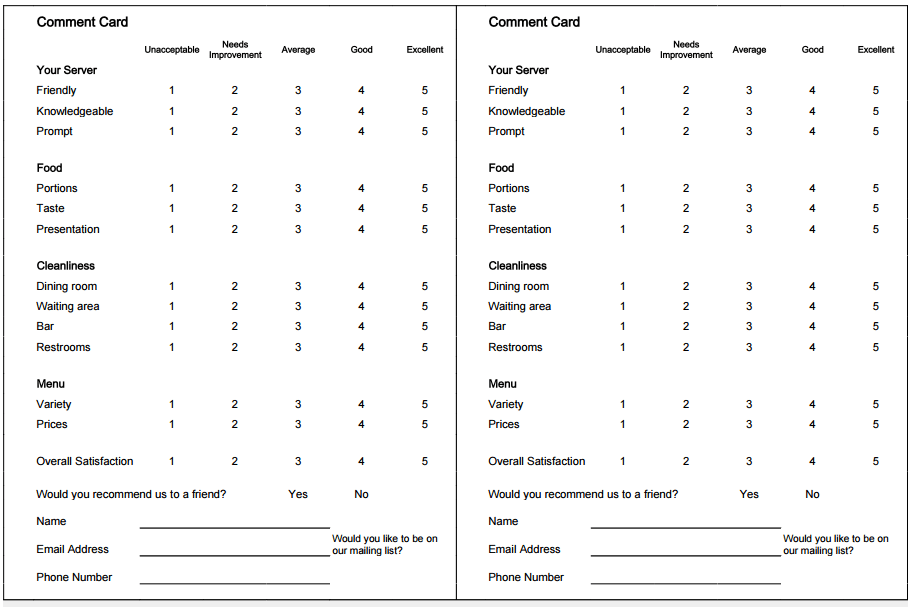




Restaurant Comment Card
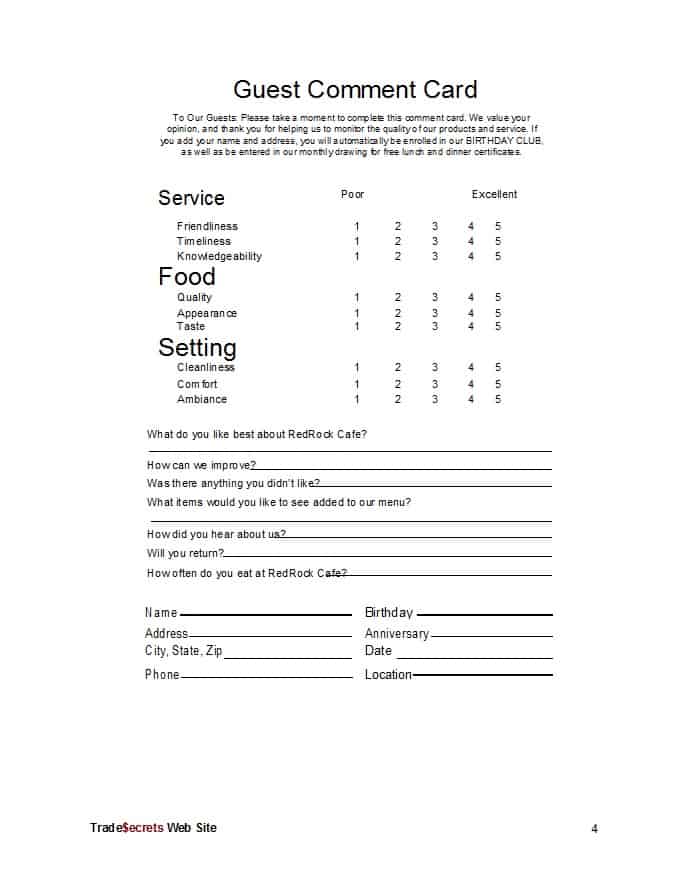
Restaurant Guest Comment Card

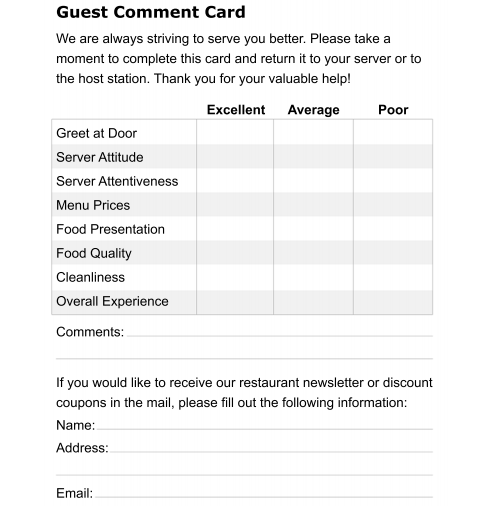
Guest Comment Card
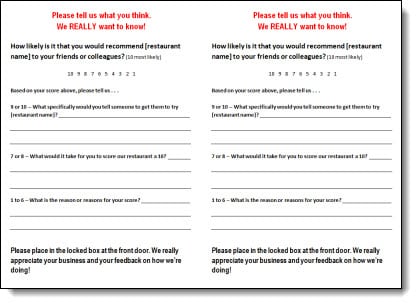
Restaurant comment card questions
How many questions should a card contain?
Use enough to cover the decisions you need to inform while keeping completion brief. A few separate ratings and one or two open questions often provide more usable feedback than a long, repetitive form.
Should guests have to provide contact details?
Not for ordinary optional feedback unless there is a justified requirement. Make follow-up details and their purpose clear, and allow anonymous responses where appropriate.
Is a blank answer the same as a low score?
No. Keep missing responses and not-applicable answers separate from ratings. Do not assume why a guest skipped a question.
Can I use a comment as a public testimonial?
Obtain appropriate permission and preserve the guest’s meaning. A private comment card does not automatically authorize publication or unrelated marketing.
Does a card establish that the restaurant is safe?
No. It records a guest’s feedback. Safety concerns need the restaurant’s established procedures and appropriate assessment, not merely a survey rating.
What files are linked in this collection?
The current gallery has one DOCX link and four ZIP links, alongside eight preview images. Check the actual archive contents and available layout before editing.


