
A credit card authorization form template helps document a customer’s permission for a merchant to process a defined charge under agreed terms. It should identify the merchant, the purpose of the payment, the amount or clearly described pricing basis, and the scope of the authorization. Completing a document does not itself process a payment, guarantee acceptance, or prevent fraud.
This page contains two historical previews with separate resource destinations: a DOC file and a PDF file. The DOC format can be a starting point for revising text, while the PDF may be more useful for reviewing a fixed layout. Inspect the actual resource before deciding whether it is editable or appropriate for your payment arrangement. The templates are examples, not a provider-approved checkout or a universal authorization policy.
Use this article for the wording and limits of permission. For a broader comparison of document purposes, see the credit card form examples. For the transaction’s actual outcome, use the payment-form guide to keep the authorization separate from the provider’s processing status. That separation makes it easier to answer both “what did the customer agree to?” and “what happened to the payment?”
Define the charge the customer is agreeing to
Begin with the transaction rather than the layout. Name the merchant and describe the product, service, reservation, or invoice involved. A phrase such as “all charges” is too vague for staff to understand the intended scope without additional terms. Use the actual authorization language required by the payment provider and the applicable arrangement, with review where the terms have legal significance.
Record an amount and currency where the charge is fixed. If the arrangement uses a variable amount, identify the agreed calculation or limit and the process for communicating the charge as required. Do not substitute a blank amount for an explanation. Staff need to know what was authorized without guessing from a later invoice or a customer’s earlier inquiry.
Separate one payment from a recurring arrangement. A one-time authorization for a deposit should not be treated as permission for future installments, unrelated purchases, or indefinite billing. A recurring arrangement needs its own clearly described frequency, pricing basis, duration or relevant conditions, and the applicable change or cancellation process. Confirm those requirements with the actual provider before adopting a sample.
The date of authorization and the intended processing date answer different questions. Record both when they matter. If a customer agrees today to a defined charge at a later stage, the document should describe that stage or date instead of implying that processing already happened. A staff member should be able to match the planned charge to the documented permission.
Build an authorization record without duplicating credentials
An administrative record can identify the customer or account, merchant, order reference, charge purpose, amount or pricing basis, relevant dates, and the approved evidence of permission. Include the contact route for questions and any terms needed for the arrangement. Keep internal review notes separate from the wording the customer agrees to.
Do not reproduce every field shown on a historical template. Some samples may contain card-number or security-code fields that are unsuitable for the organization’s retained documents. Use the payment provider’s approved process for necessary collection of card information, and ask the provider which references can appropriately appear in your retained authorization record.
PCI SSC states that customer permission does not allow an entity to retain a card verification code after authorization of the transaction. Signing a form is therefore not an exception permitting a business to keep that code for later charges. Design the documentation around the approved process rather than treating a customer’s signature as a general waiver of payment-security requirements.
A document containing an order identifier and the approved authorization evidence can help staff locate the relevant arrangement without becoming a copy of payment credentials. Limit access according to the actual business process and apply the organization’s approved retention procedure. There is no universal instruction here to keep every completed form for 120 days; applicable requirements depend on the provider, arrangement, records, and rules.
Fictional example: a defined service deposit
Suppose a fictional photography studio agrees a project price of 800 with its customer and a deposit of 200. The authorization record names the studio, references order SO-312, identifies the deposit purpose, states the currency and amount, and records permission through the provider-approved process. It does not include an invented signature or copy card credentials into the sample.
Staff confirm that the permission applies to the 200 deposit. They do not assume it also authorizes the remaining 600, a new service, or an additional cancellation charge. Those items need the terms and authorization appropriate to their own arrangement. The example is about defining the scope of a charge, not establishing a universal rule for deposits or cancellation fees.
The customer then asks to reduce the project scope before the planned deposit is processed. Staff follow the agreed change process, record the revised order and deposit amount, and confirm what permission supports the revised charge. They preserve the earlier authorization with its superseded status rather than silently editing it to make the historical agreement appear different.
When the provider reports the payment result, staff reference that transaction from the administrative record. A declined attempt does not invalidate the fact that the customer gave permission, but neither does that permission prove the funds were received. The related service order continues to describe the agreed service, while the payment result records the processing event.
Review recurring arrangements separately
For recurring services, a practical review asks whether the customer can understand the frequency, amount or calculation, and circumstances in which billing changes. Explain the applicable route for updates or cancellation using the business’s actual current terms and provider requirements. A template with a single signature line does not supply those terms automatically.
Keep the authorization version connected to the service or account reference. If the arrangement changes, record the change date, the applicable customer agreement, and which version staff should use. An old document should not remain the operational instruction simply because it is the only signed page in a folder. Identify who reviews exceptions before staff initiate a charge outside the stated scope.
A recurring authorization is also distinct from successful recurring payments. Track each event through the provider’s system and the approved payment records. If a transaction fails, use the established customer-contact and retry process. Do not change the documented amount, keep security codes for future use, or make repeated attempts based only on a generic form’s broad wording.
Prepare the blank master for staff
Replace historical business names, unrelated service instructions, and example amounts with clear field labels. Leave the real customer’s authorization evidence, dates, and transaction results blank until the appropriate event occurs. Label instructional examples so they cannot be mistaken for completed records. Retain a clean master rather than copying the last customer’s document and overlooking a signature or amount.
Ask the process owner to review the wording, necessary fields, access arrangements, and handoff to the payment provider. Staff should know who confirms scope and who handles customer changes. A short completion note can identify the order reference and the next step, but should not claim approval or processing success unless supported by the actual event.
The form’s appearance matters less than whether the process is clear. Readers should be able to find the merchant, charge purpose, amount or basis, authorization date, and contact route without searching through repeated text. Remove duplicate sections and unrelated personal information. Use the DOC and PDF resources below as starting points for review, while keeping their original files separate from your approved business master.
Sample Credit Card Authorization Form
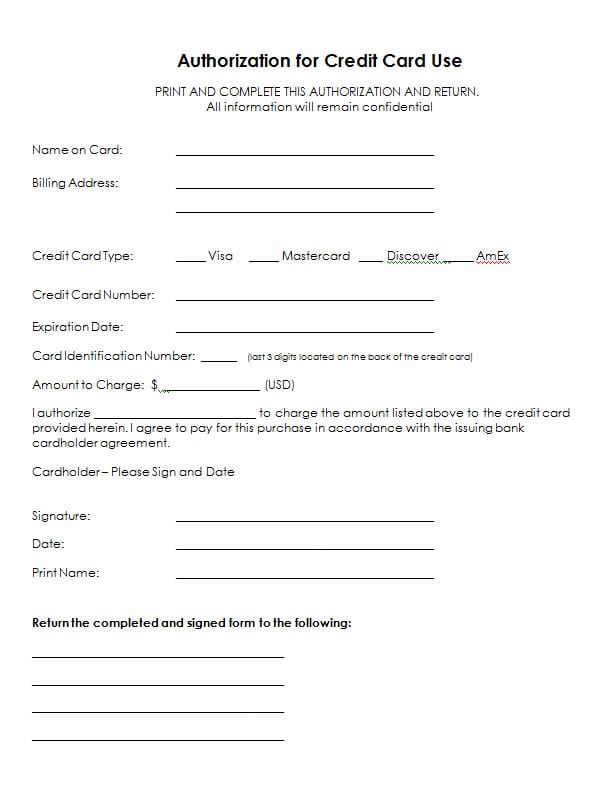

Credit Card Authorization Form Printable
Frequently Asked Questions
Does signing the form process the payment?
No. It documents permission through the applicable process. The payment provider separately handles the transaction and reports its result.
Are both resources Word documents?
No. The existing destinations are a DOC file and a PDF file. Review each resource’s actual contents and editability before selecting a working format.
Does authorization guarantee that fraud or disputes cannot occur?
No. A form cannot guarantee a legitimate transaction, successful processing, or the absence of disputes. Follow the provider’s actual authorization and security procedures.
Is a deposit authorization permission to collect the entire balance?
Not automatically. Record the agreed scope and obtain the authorization appropriate to any later amount or arrangement rather than extending a specific deposit permission by assumption.
Can a customer authorize us to retain the security code?
Customer permission does not permit an entity to retain a card verification code after transaction authorization under PCI DSS. Use the provider’s approved process for card-data handling.
Must every form be retained for 120 days?
There is no universal 120-day rule supplied by this template. Use the retention procedure appropriate to your provider, arrangement, records, and applicable requirements.
What should happen if the amount changes before processing?
Follow the agreed change process, document the revised amount and the supporting permission, and identify the earlier version as superseded where appropriate. Do not rewrite historical authorization evidence.
Should recurring billing use the same wording as a one-time charge?
Review it separately. The document needs the actual frequency, amount or calculation, relevant conditions, and change or cancellation process required for that arrangement.

