
An action plan template connects an objective to specific steps, owners, resources and evidence of completion. Identify dependencies and review dates, and record what blocks progress. A practical plan makes the next action clear while keeping intended results separate from achieved ones.
Use a logic model to explain the expected pathway, a decision tree to compare routes and a daily activity log to review actual work. Keep the plan concise enough to update as evidence or circumstances change.
The three previews below link to one external ZIP resource and two PDF resources. Review the actual files before deciding how to edit them; the PDFs can serve as layout references, and the archive’s contents need individual inspection. This collection is not three confirmed editable Word documents, and downloading a form does not establish that its sample steps suit your objective.
Use the plan for the route from an objective to a reviewed outcome. A to-do list is useful for a simple set of tasks, while a daily schedule allocates selected work to time on a particular day. The action plan adds the objective, dependencies, ownership, and completion evidence needed to connect those tasks.
Define the objective and the result you will review
Write an objective that names the intended change and the scope. “Prepare and review a current supplier contact directory for the purchasing team” is clearer than “improve communication.” It describes a result that staff can inspect and identifies who the work is for.
Separate the desired result from the activity used to reach it. Sending a request for updated details is an activity. Having reviewed current contact routes in a maintained directory is the intended output. The plan should show both, so a completed email task does not automatically become proof that the whole objective was achieved.
Choose a realistic review point and identify what evidence will be used. A dated directory, a completed review note, or an approved document version may provide the relevant evidence depending on the goal. A plan should not claim that any goal is achievable simply because steps have been written down.
Break the work into actions with clear outputs
Use an action verb and a specific object. “Review the five supplier contact routes” is more precise than “supplier work.” State what the owner will produce or confirm, and avoid combining several different decisions in one row that can only be marked all complete or all incomplete.
Make large tasks smaller when ownership or dependencies differ. Gathering details, reviewing uncertainty, approving the master, and replacing printed copies may need separate actions. That separation shows where the work is waiting rather than hiding every delay inside a single broad task called “update directory.”
Keep the level of detail practical. A short, routine plan may not need every minor keystroke recorded. The useful question is whether the action can be assigned, understood, followed up, and checked. Detail that does not affect those functions can remain in the supporting procedure instead of cluttering the plan.
Assign an owner and identify the people involved
Give each action a clear owner for follow-up. Other people can contribute, but a row labeled “team” may leave everyone assuming someone else will coordinate it. Where a group genuinely owns the work, identify the person or route responsible for reporting its status.
Distinguish the action owner from the approver or reviewer. A staff member may prepare a document while another person decides whether it is ready for use. Marking preparation complete should not automatically mark approval complete. The plan needs to reflect the actual decision process rather than flatten every stage into one checkbox.
Confirm the assignment through the real process. A name typed into a blank template does not establish that the person accepted the work or has the authority and resources to do it. Record the status accurately and resolve an unconfirmed assignment before relying on it as a commitment.
Fictional example: updating a small directory
Consider an invented office objective: prepare a reviewed supplier contact directory by the end of the month. The scope is five active suppliers used by one purchasing team. It does not include the organization’s full customer database or private employee contacts.
The first action is to confirm the information fields needed for that purpose. The owner prepares the proposed labels and identifies the reviewer. The next action gathers current routes through the approved sources. A third action reviews uncertain entries and records their status instead of inventing missing names or numbers.
After the reviewer approves the maintained source, a final action replaces the printed working copies used by the team. The completion evidence is the current directory version and the recorded replacement of those copies. Sending a request for information alone does not satisfy that completion criterion.
A contact information form can support the collection step, while the plan tracks who owns the work and which actions remain open. The forms and the action plan have different purposes. Reference the supporting records rather than duplicating private contact details into a broadly shared plan.
Put dependencies and resources where they are visible
A dependency explains what must happen before an action can proceed. Reviewing a directory depends on receiving sufficient information; replacing copies depends on the current master being approved. Showing that order helps staff understand why a task is blocked and what needs attention first.
Do not turn every preference into a strict dependency. Some work can proceed in parallel, such as preparing the layout while details are being confirmed. Identify the actual constraint so the plan does not delay tasks unnecessarily or pretend that everything must wait for one early action.
Record the resources relevant to the work: staff time, access to source records, the approved editing tool, or a confirmed budget where applicable. An assigned deadline is not realistic if the owner cannot obtain the necessary access. Keep a proposed resource separate from one actually approved or available.
Use statuses that explain the next step
Statuses such as not started, in progress, awaiting information, awaiting review, and complete can show different conditions. Define them for the plan’s purpose. “In progress” should not become a permanent label that conceals a specific unresolved decision.
For a blocked action, state the blocker, who is addressing it, and the next review point. A note saying “delayed” does not tell the reader whether the owner is waiting for a supplier, approval, or access. The plan should make the follow-up actionable without requiring a lengthy narrative in every row.
Record completion only when the defined output or check supports it. If the owner prepared a draft but the required review is outstanding, keep that review open. A completion date should describe the actual event rather than the originally planned date copied into the finished column.
Review and revise without losing the objective
At each review, compare progress with the intended outcome, not just the number of ticked rows. Several minor actions can be complete while the critical approval or information remains missing. The review should identify the constraint affecting the result and decide the appropriate next step.
When scope, timing, or responsibility changes, record the change and its reason through the actual planning process. Do not silently move overdue dates forward and present the plan as though no delay occurred. A revised plan can be useful while still preserving what changed and why.
Remove or redefine work that is no longer needed. Carrying obsolete tasks forward can obscure the current priorities. At the same time, preserve the relevant completed history and source records rather than rewriting a previous outcome to match a new objective.
Keep the plan readable and reusable
Choose a layout with room for the action, owner, target date, dependency, status, and completion reference where those fields matter. If an explanation is lengthy, keep it in a supporting record and add a clear reference. The plan should remain usable during a short progress review.
For a new plan, remove prior names, actual dates, costs, and completion statements from the master. Label fictional examples and replace them with the real objective and assignments. A clean structure saves preparation time; it does not guarantee delivery or make an unapproved action authorized.
Close the plan with the outcome actually reached and any unresolved follow-up. A reviewed directory might be complete for its defined five-supplier scope while a separate improvement remains for another period. State that boundary so readers understand the result and do not infer that all related work in the organization has been finished.
Download Action Plan Templates:
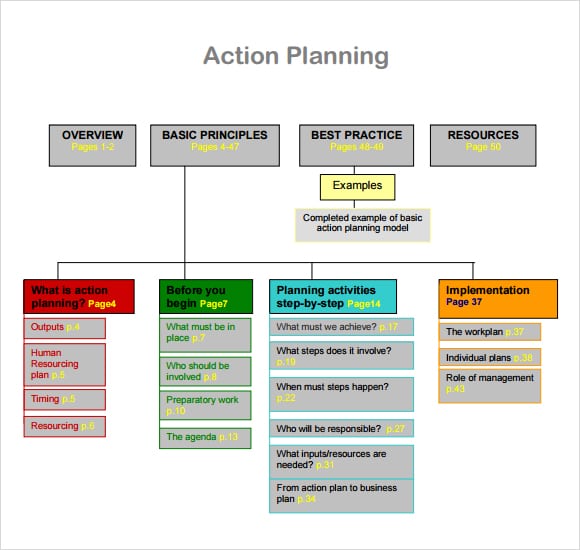
Here is the preview of this action plan template.

Click on the download button and make this action plan template your own.

Business Action Plan Template:

 Action Plan Template Chart PDF:

Frequently Asked Questions
Are all three resources editable Word files?
No. The existing destinations include a ZIP archive and two PDFs. Review their actual contents and editing features before choosing a working format.
How is an action plan different from a to-do list?
The action plan connects tasks to an objective, owners, dependencies, and completion evidence. A simple to-do list may only need the tasks themselves.
What makes an action clear?
Name the specific activity, its output, owner, and relevant timing. Avoid broad labels that leave the next step or completion criterion uncertain.
Can the same person prepare and approve an item?
Use the actual review process. Keep preparation and any required approval distinguishable even when one person legitimately performs both roles.
What should a blocked action show?
Identify the blocker, the person addressing it, and the next review point. “Delayed” alone does not explain what needs to happen.
Should I move missed dates forward without a note?
Record revisions and their reasons through the actual process. Preserve enough history to explain why the timing changed.
Does completing every row guarantee the objective?
Check the defined outcome and evidence. A set of completed activities may still fall short if an important output or required review is missing.
Can I copy the fictional directory plan?
Use its structure, but replace the invented scope and events with your real objective, assignments, resources, and completion checks.
