
A proposal form template organizes an idea, project or service for a reviewer to assess. State the purpose, scope, assumptions, estimated resources and next decision. Adapt the fields to the proposal type rather than assuming the same layout suits a business offer and a regulated application.
Use a business proposal email for the covering message, an advertising proposal for campaign detail and a job proposal when the decision concerns a role. Keep proposed terms clearly labeled until the appropriate review and acceptance occur.
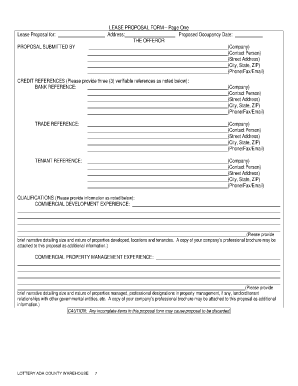
The five previews below cover different contexts. The existing labels include a general proposal, a blank proposal, an event-insurance proposal, another proposal sample, and a rental proposal. Four previews have external links and the rental graphic is unlinked. Inspect the actual resource before choosing it; an insurance or finance application is not a generic project-offer form.
Use a general form for a defined business or project proposal. For a regulated application or provider-specific process, use the current required form and instructions. Do not assume that filling out any document titled “proposal” creates insurance coverage, funding, a rental agreement, or authority to begin work.
Identify the decision the form supports
Write the requested decision near the beginning. The reviewer might be asked to approve a budget review, consider a service offer, authorize a pilot, or request more information. These are different stages.
State who is making the proposal and who is expected to review it. Use a relevant project or enquiry reference so the document can be matched to the correct process. A form addressed only to “management” may be hard to route.
Explain the need or opportunity with supported information. A concise description of the current situation is more useful than broad claims that the project will revolutionize the business.
If the proposal responds to a formal request, follow its instructions and evaluation requirements. A convenient template does not justify omitting a required section or submitting through the wrong channel.
Fields for a general project proposal
A useful general form can include the proposal title, proposer, date, purpose, scope, deliverables, schedule, resources, estimated costs, assumptions, and requested next step. Add fields because they help the decision, not because the page has empty space.
Describe the proposed outcome in concrete terms. “Produce a revised customer-information booklet covering the five listed services” is more assessable than “improve customer communication.”
List the work included and important exclusions. If the proposal covers a review rather than implementation, say so. Do not let a broad heading imply work that the price or schedule does not cover.
Identify the people or inputs needed from the recipient. Access to information, a nominated contact, and review feedback can affect feasibility and timing. Make material dependencies visible.
Use a status field to distinguish draft, submitted, under review, revised, and approved where appropriate. A filled-in approval box should reflect an actual authorized decision, not the writer’s expectation.
A fictional small-project example
Imagine a team proposing an update to a short customer-information booklet. The purpose is to make the current service descriptions consistent and easier to understand.
The form could state that the project covers five named service sections, one revised draft, and one consolidated review round. It could exclude a full rebrand, new photography, and website publication.
The proposer would identify the staff member who provides current service information and the person authorized to approve the wording. The schedule would begin after those inputs are received, rather than promising a date independent of access and review.
An illustrative estimated cost of 550 currency units might be shown as provisional pending scope confirmation. If that estimate excludes printing, the form should say so. Do not present a partial cost as the complete cost of producing and distributing the booklet.
The requested decision could be “Approve preparation of a detailed scope and confirmed quotation.” That is narrower than permission to begin every activity described. The approval record should match the actual stage.
This fictional example shows how a proposal can be specific without pretending every detail is settled. Replace the sample information with verified facts and the appropriate organizational process.
Keep estimates and approved figures distinct
Label an estimate as an estimate and explain its basis. A unit quantity, rate, or supplier quotation may support a cost figure. A rounded guess should not look like a confirmed price merely because it is placed in a table.
A quotation template can help organize a separate priced offer when needed. Check that its scope and assumptions match the proposal form. Different versions of the same cost can leave the reviewer uncertain about what they are considering.
State the currency and relevant inclusions or exclusions. Tax, delivery, equipment, and ongoing costs may require separate consideration. The form does not determine the tax treatment or accounting method.
If the proposal asks for funding, explain what the funds would be used for and which costs are still uncertain. Do not guarantee a return or claim that approval follows automatically from a well-formatted application.
Deliverables and review criteria
Explain what the recipient would receive if the proposal proceeds. A list of activities may not make the output clear. “Review records” and “deliver a report of findings” describe different parts of the work.
Identify how the output would be reviewed and by whom. For the booklet example, the reviewer could check coverage of the listed services, accuracy against supplied information, and use of the agreed format.
Avoid criteria based only on general satisfaction. A specific review question is easier to manage than a promise that every reader will be delighted. Keep the criteria within the proposed scope.
A statement of work template can help define the detailed work once the appropriate stage is reached. The proposal form can summarize the offer, while the SOW describes agreed outputs, responsibilities, timing, and review arrangements.
Understand the insurance and finance examples
An event-insurance proposal form is used in an insurance context, where information may help a provider assess an application. It is not interchangeable with a proposal to organize the event or with evidence that insurance has been arranged.
NAIC consumer guidance explains insurance in terms of a policy contract. Do not assume that submitting a sample application proves coverage. Confirm the actual arrangement and documents through the insurer’s appropriate process.
The gallery also contains a finance-provider destination. Use the provider’s current form and instructions for an actual application, and submit truthful information through the appropriate secure channel. A generic preview does not establish funding approval or suitability.
Do not remove material questions or declarations from a provider’s form simply because they seem inconvenient. Ask the provider or appropriate adviser when a requirement is unclear. Do not invent financial figures, signatures, or supporting documents.
The rental preview is another context. A proposed rental arrangement, an application, and a signed agreement have different roles. Confirm which document you need and the requirements relevant to the actual property and arrangement.
Signatures and acceptance areas
Check what a signature area actually means. It may acknowledge submission, confirm information, record internal approval, or accept an offer. Those purposes should not be confused.
Do not add a signature block labeled “accepted” when the intended next step is only review. Equally, do not dismiss an acceptance field as decorative; its wording and the document’s effect may matter.
For material commitments, use the appropriate authorized review and agreement process. The legal effect depends on the content and circumstances, not simply the file name or the word “template.”
Keep approval dates, names, and roles accurate. A copied signature from an older document does not authorize a new proposal. The final record should show the actual decision made.
Customize without losing the form’s purpose
Choose the resource that matches the transaction or review process. A general proposal layout can be adapted more freely than a provider-specific application whose fields and declarations serve a particular purpose.
Replace sample names, dates, references, amounts, and descriptions throughout the file. Check text boxes, headers, and footers. Remove unsupported claims about approval, profitability, or interactive functionality.
Give longer answers enough space to be readable. If a short form cannot contain essential detail, use a clearly referenced attachment rather than shrinking the text until it is difficult to review.
Confirm whether the resource is a PDF, editable document, web form, or example image. A static preview does not establish that fields are interactive or that calculations work automatically.
Submit a clear version and track feedback
A business proposal email template can help prepare a concise covering message. Identify the proposal, requested decision, and attached version so the recipient knows what to review.
Check the final document and attachment before sending. Confirm the recipient and use the appropriate submission channel, especially when the form contains private or financial information.
If the reviewer requests changes, identify the revised version and explain material differences. Do not leave several conflicting copies all labeled final. Keep the record of what was submitted and what was approved.
A useful proposal form supports an informed review. It cannot guarantee funding, business, insurance, or acceptance. Its quality comes from accurate information, a suitable context, and a clear decision process.
Proposal Form Example
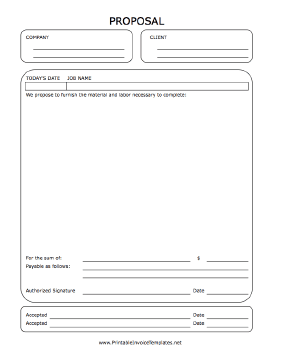

Blank Proposal Form
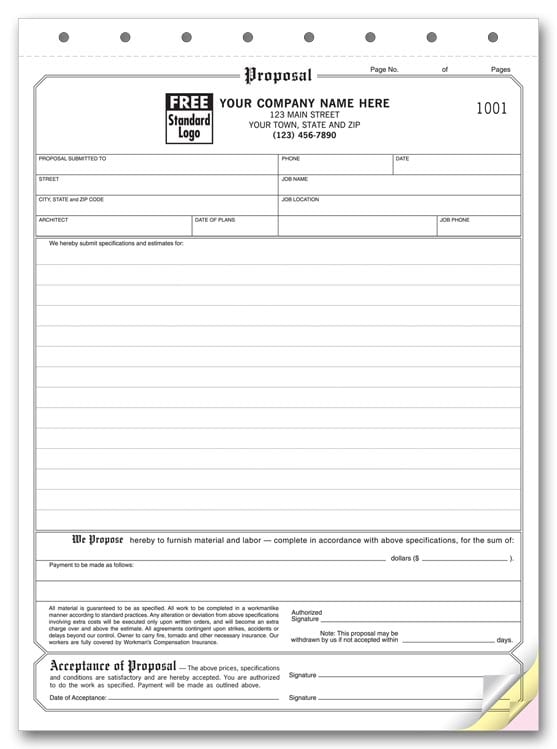
Event Insurance Proposal Form
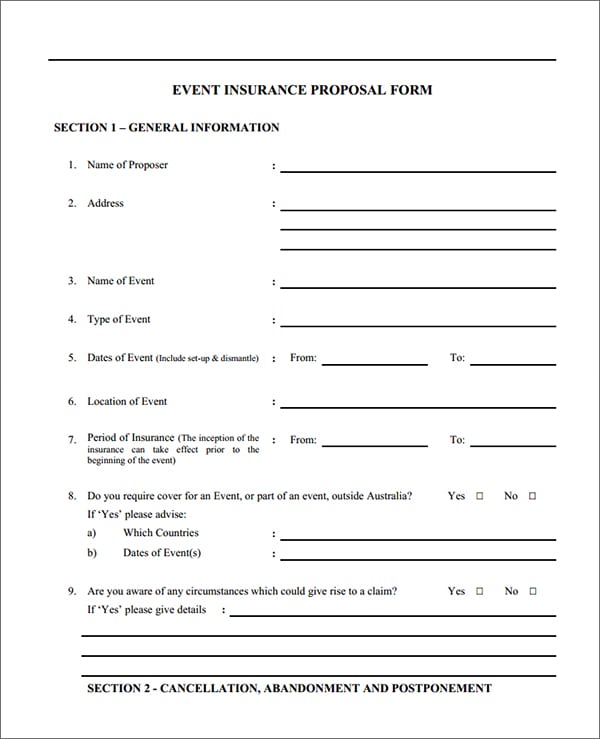
Proposal Form Sample
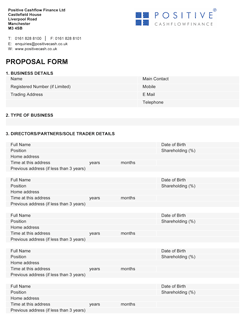
Rental Proposal Form
Proposal form questions
Are all five previews general business proposals?
No. The gallery includes general, insurance, finance-related, and rental contexts. Choose the actual resource that fits your purpose.
Does submitting an insurance proposal prove coverage?
Do not assume so. Confirm the actual insurance arrangement and documents through the insurer’s process. A sample form is not evidence of coverage.
What should the approval field record?
The actual authorized decision and its scope. Distinguish permission to prepare more detail from permission to begin work or accept an offer.
Can I remove questions from a provider’s application?
Follow the provider’s current instructions and ask when a requirement is unclear. Do not omit material information or declarations merely to simplify the form.
How should I present an uncertain price?
Label it as provisional, explain the basis and assumptions, and identify what must be confirmed. Keep it consistent with any quotation.
Does the rental preview have a download link?
The current gallery’s rental download graphic is unlinked. Other resources have external destinations whose actual formats need to be checked.
