
Business introduction email templates help explain who is contacting the recipient and why the message matters to them. Use a specific reason for writing, a concise description of the business and one practical next step. Personalize the message without adding unverified claims about the recipient.
Compare organizational wording in company introduction emails, use proposal emails for a defined offer and choose a business introduction letter when a formal letter is more suitable. Match the format to the relationship rather than treating every first contact as a sales proposal.
This page now includes two original downloads: First Contact Business Introduction Email and Warm Referral Introduction Email. Choose the First Contact Business Introduction Email when there is no existing referral. Choose the Warm Referral Introduction Email when a mutual connection has authorized the introduction.
The new files appear first with previews and clearly labeled download buttons. The original gallery and its resource examples follow the practical guide; descriptions of the older collection refer to that original gallery. The new PDFs have fillable fields; save a local copy, open it in a compatible PDF viewer, and review the saved result before printing or sharing.
Use this page for introducing a company or proposing a relevant business conversation. For introducing a new account contact to an existing client, see the introduction email to client samples. A company profile can provide fuller background when needed, but the opening message should remain understandable without requiring the recipient to read a long attachment.
Free Business Introduction Email (Word Template)
Download this ready-to-use, fully editable business introduction email in Microsoft Word (.docx) format. Fill in the fields, adjust the layout to your needs, then print or save it.
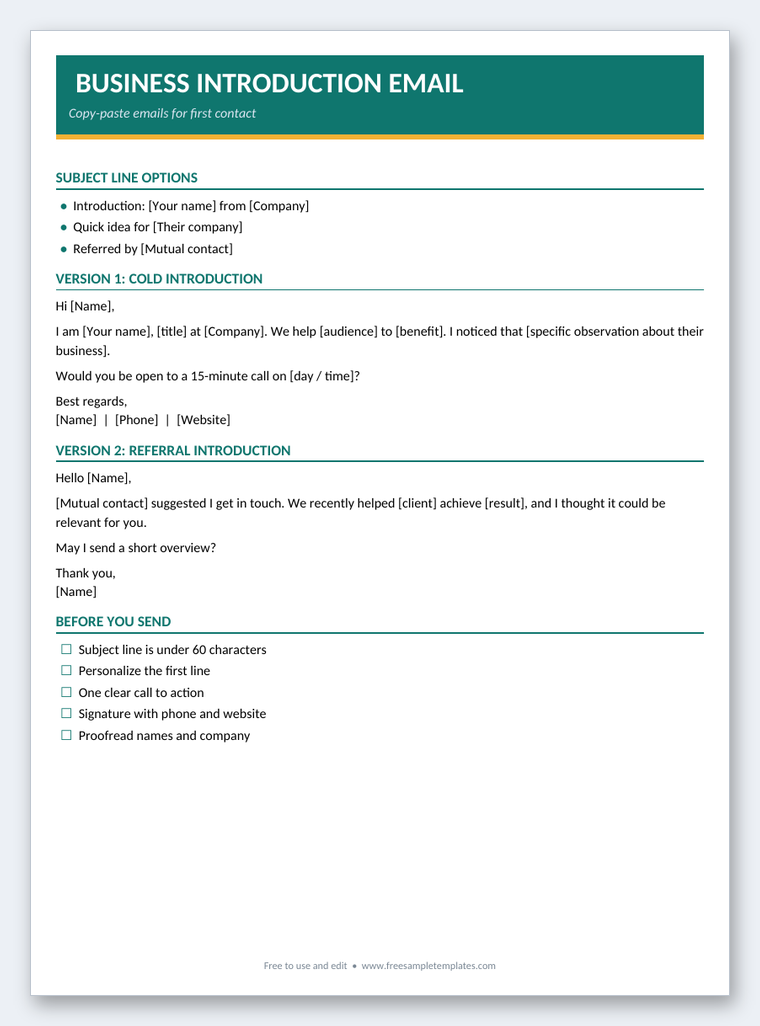

Two new templates to download
Choose the First Contact Business Introduction Email when there is no existing referral. Choose the Warm Referral Introduction Email when a mutual connection has authorized the introduction.
First Contact Business Introduction Email
Introduce a relevant business capability with a clear optional next step.
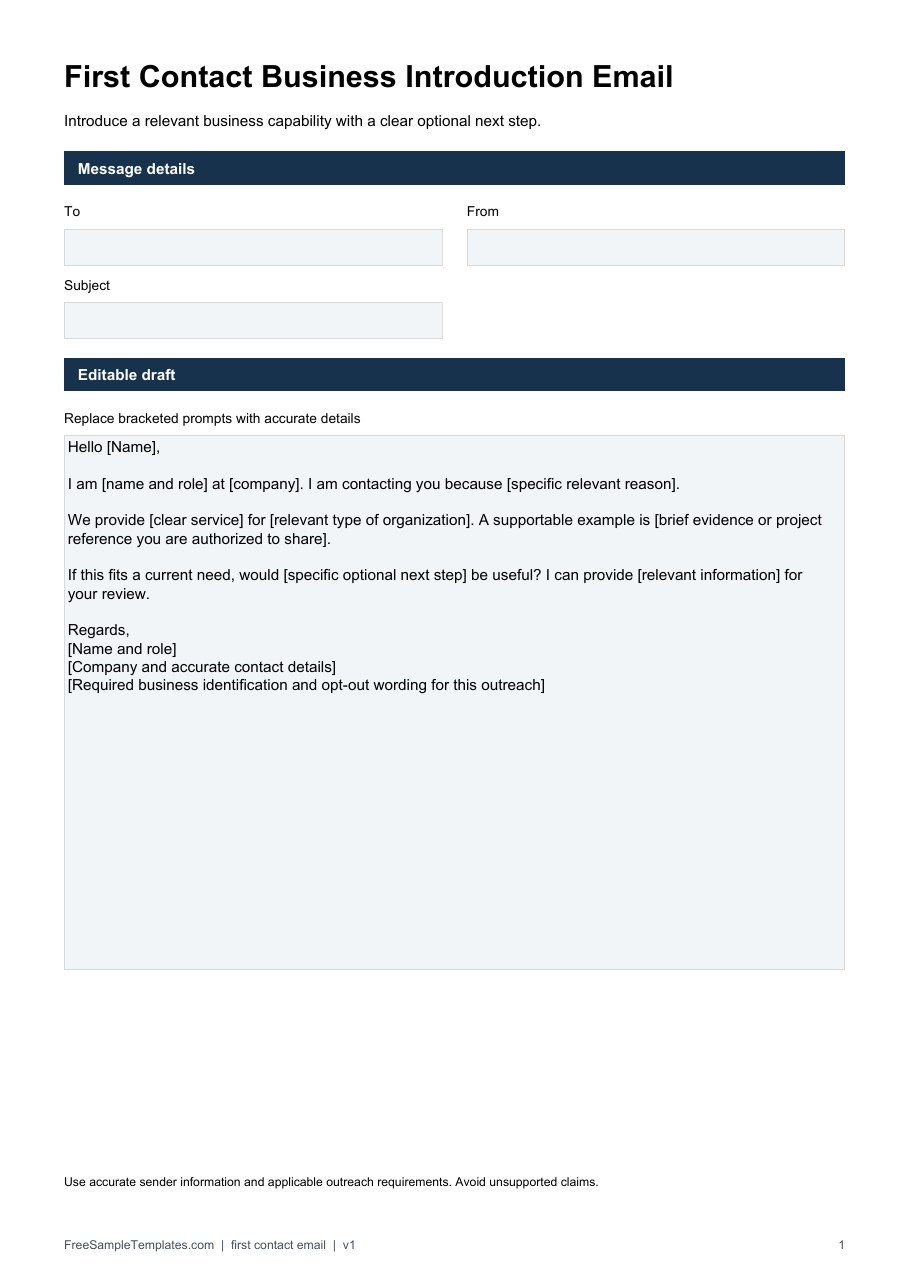
Download First Contact Business Introduction Email (PDF)
Warm Referral Introduction Email
Introduce a business through an authorized mutual connection.
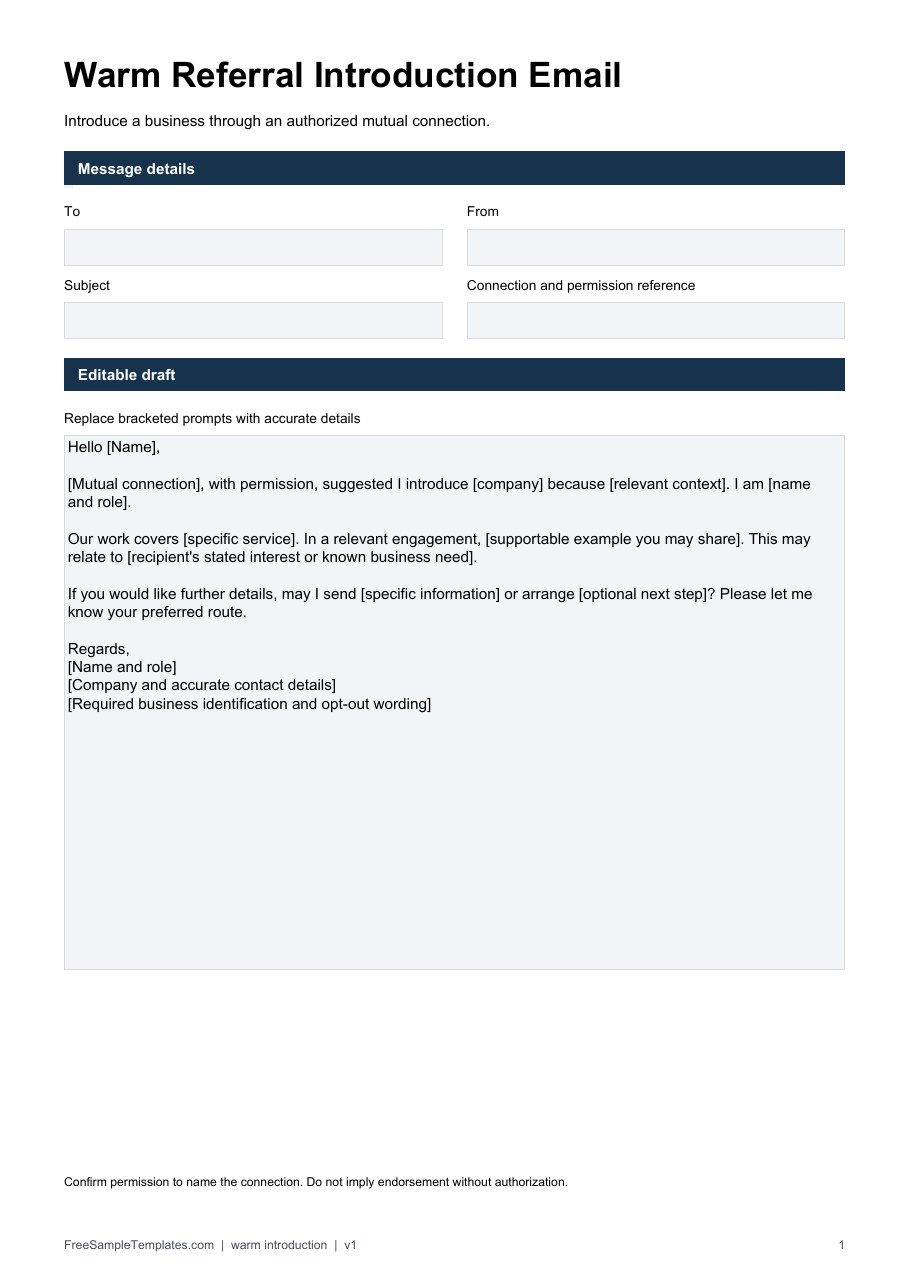
Download Warm Referral Introduction Email (PDF)
How to use the new downloads
Both fillable PDFs contain reusable draft wording with bracketed prompts. Replace each prompt with a specific relevant reason, a clear capability, a supportable example, and a small optional next step. The referral version includes a connection and permission reference so the sender checks authorization before naming another person.
A fictional first contact could offer a brief capabilities summary relevant to an identified project instead of attaching a large unsolicited sales pack. For a warm introduction, state the connection accurately without implying an endorsement. Review sender identification, required business information, and applicable opt-out wording before sending; a template does not establish consent or guarantee a reply.
What Is a Business Introduction Email?
A business introduction email is a professional message sent to establish contact with a person or organization for the first time. It may be used to introduce a company to a potential customer, present services to a prospective client, contact a supplier, introduce a new employee, or begin a relationship with a business partner.
A business introduction email template helps organize the message so that the recipient quickly understands who you are and why the communication is relevant. Unlike a generic promotional email, an effective introduction should focus on establishing a professional connection before asking the recipient to take action.
Business Introduction Email to Client
A business introduction email to a client can be used when a company wants to introduce its products, services, expertise, or team to a potential customer. The message should briefly explain what the company does and how it may be relevant to the recipient.
Keep the introduction concise and personalized. Mentioning the recipient’s company or a specific business need can make the email more relevant than sending a generic message to a large list of contacts.
Company Introduction Email Template
A company introduction email template is useful when introducing an organization to prospective customers, suppliers, contractors, distributors, or other businesses. It can include a short company overview, primary products or services, industry experience, website or contact information, and the reason for contacting the recipient.
The existing page also provides related company introduction email samples, which can be useful when a more detailed company overview is required.
Professional Business Introduction Email
A professional introduction email should have a clear subject line, appropriate greeting, concise introduction, relevant business information, and a simple closing. Avoid filling the first email with excessive promotional language or unnecessary company history.
The goal is to establish credibility and give the recipient a reason to continue the conversation. Depending on the purpose, the closing can invite the recipient to reply, schedule a meeting, review your services, or continue the discussion.
Editable Business Introduction Email Template
An editable business introduction email template can be customized for different industries and situations. You can replace the sample text with your company name, recipient information, products, services, business purpose, and preferred call to action.
These templates can also be adapted for supplier introductions, partnership proposals, customer outreach, contractor communication, and professional networking. The page specifically identifies prospective clients, employees, marketers, contractors, suppliers, and other business entities as potential recipients.
How to Write a Business Introduction Email
Start with a clear and relevant subject line. Introduce yourself and your company in the opening sentence, then briefly explain what your business does. Next, explain why you are contacting the recipient and how the relationship could be useful.
Keep the message focused and professional. End with your contact information and a straightforward next step. Before sending, check the recipient’s name, company name, email address, and any claims about your products or services.
A strong business introduction email template saves time while still allowing you to personalize each message. For better results, treat the template as a framework rather than sending exactly the same email to every potential customer or business contact.
Match the message to the relationship
A first contact with a supplier should explain the purchasing or service question, not use the same wording as a sales pitch. A potential partner needs to understand the proposed area of cooperation. A prospective customer needs a concise, accurate explanation of the service and why the message is relevant to their role.
Avoid assuming that the recipient has a particular problem merely because of their job title. If you refer to a published project or an earlier conversation, check the detail and describe it accurately. Do not imply that someone recommended you, that a meeting occurred, or that a partnership exists unless it is true.
Use a subject that describes the actual purpose. “Introduction: display-production services from Alder Studio” is clearer than “Important account update” when no account relationship exists. A subject designed to look like a reply to an earlier conversation can mislead the recipient if there was no earlier exchange.
Fictional supplier inquiry
The following example uses invented names and details. Subject: “Supplier inquiry from Alder Studio.” Message: “Hello Purchasing Team, I coordinate production planning at Alder Studio. We are reviewing suppliers for a small run of printed display panels and would like to understand the specifications and information your team needs for a quotation. Could you direct me to the appropriate contact for that inquiry? Thank you, Morgan, Production Coordinator.”
This message states the role, reason for contact, and one manageable next step. It does not invent an urgent deadline, claim that a purchase is approved, or request a full proposal before the supplier knows the requirement. For a real message, use the actual recipient, business, scope, and contact information.
If the supplier responds, the next exchange can provide the relevant specifications and request the quote through the appropriate process. The introductory email remains a first-contact message; it should not be treated as a purchase order or evidence that terms have been accepted.
Fictional partnership introduction
Subject: “Introduction regarding a community display project.” Message: “Hello Casey, I manage project coordination for Alder Studio. Our team is considering a public display about local crafts, and your organization’s work in that area appears relevant to the planning discussion. Would you be the right person to ask about a short exploratory conversation? We are still defining the scope and are not requesting a commitment at this stage. Regards, Morgan.”
This example makes the stage of the idea clear. It proposes a conversation rather than presenting an exploratory contact as an agreed partnership. A real message should identify the actual reason the recipient is relevant and avoid making unsupported claims about their organization’s interests.
If the recipient directs you elsewhere, update the contact route through the appropriate process. Do not assume permission to broadcast the exchange or add every copied address to a new promotional list. Keep the purpose of the communication clear as the conversation develops.
Keep company claims specific and supportable
Describe what the business actually offers and the scope of any experience you mention. “We provide short-run display design and production coordination” is more useful than an unexplained claim to be a leading global provider. Avoid invented customer names, certifications, project counts, or results to make the introduction sound more established.
Where a business reference letter supports a relevant relationship, use it only with the appropriate authorization and context. A reference about one kind of work should not be presented as an endorsement of every service. An introductory email can mention that supporting information is available without attaching unrelated documents by default.
Choose one clear response request. Asking for a contact name, permission to send specifications, and a 30-minute meeting all at once can make the next step less obvious. Select the action that fits the relationship and stage of the discussion, with enough context for the recipient to decide whether to respond.
Review links, attachments, and the closing
Include the sender’s real role, business, and appropriate contact route. Check that links lead to the intended material and that attachments are actually included when the text says they are. Do not attach an old proposal or another customer’s document because it happens to be saved beside the template.
For a first introduction, a short message with a relevant reference can be easier to review than several attachments. If the recipient requests further detail, send the material suited to that request. A company profile, quote, technical paper, and reference letter answer different questions; the email should explain why a particular document is being shared.
Commercial messages can be subject to specific rules. The US FTC’s CAN-SPAM guidance addresses accurate sender information and subject lines among its requirements. Check the requirements applicable to your message and jurisdiction rather than assuming that calling it an introduction makes every promotional message exempt.
Follow up with context
If a follow-up is appropriate under the actual contact process, reference the original purpose and state any relevant new information. Do not pretend that silence is acceptance or that the recipient agreed to a meeting. A follow-up can ask whether another contact is better suited without repeating an entire promotional pitch.
When the conversation changes stage, change the document purpose accordingly. A supplier’s response may lead to a specification or quote request; an exploratory partnership discussion may lead to a defined proposal. Keep those later commitments in the appropriate records rather than relying on a friendly introduction as evidence that the arrangement was approved.
Keep a clean master for the structure and personalize the facts for each message. Remove invented names, dates, and sample claims before use. The template can help write a clear introduction, but it cannot guarantee a reply, a sale, or a permanent client relationship.
Frequently Asked Questions
What formats are the two new downloads?
The two new files are fillable PDFs with different purposes and matching previews. Open them in a compatible PDF viewer, complete the fields and save your copy. They are not DOCX files, and numerical PDF fields do not calculate totals automatically. The original gallery has its own mixed resources and formats.
How is this different from introducing a new client contact?
This page focuses on first contact or a company-level introduction. A new account-contact email explains who will handle an existing client’s communication and how the handover affects them.
What should the subject line say?
Describe the actual purpose clearly. Do not imply an account update, prior conversation, or existing relationship if that is not true.
Can I use the fictional examples unchanged?
Use their structure only. Replace every invented name and detail with accurate information, and choose a purpose appropriate to the actual recipient.
Should I attach the whole company profile?
Include fuller background only when it is relevant to the contact. The short introduction should still explain who you are and why you are writing without relying on the attachment.
What is a useful first response request?
Choose one manageable next step, such as identifying the right contact or asking whether a short discussion is appropriate. Match it to the stage of the relationship.
Is every introduction email exempt from commercial-email rules?
No. Consider the actual message and applicable requirements. Calling a promotional email an introduction does not by itself determine its treatment.
Can a template guarantee a new client?
No. It supports clear communication but cannot establish the recipient’s interest, agreement, or future business relationship.
