
Bank statement templates help organize learning examples or internal transaction comparisons. Label them as worksheets, define the period and opening balance, and check each entry against its source. An internally prepared layout does not become a statement issued by a financial institution.
Review transactions with a payment history template, track checks on a printable check register and connect business payments to an invoice. Keep the institution’s original statement separate from your comparison worksheet so discrepancies can be investigated without altering the source.
This page now includes two original downloads: Internal Transaction Register and Bank Statement Comparison Worksheet. Choose the Internal Transaction Register to record your own inflows, outflows, and calculated balance. Choose the Bank Statement Comparison Worksheet to review a genuine statement balance against book records and identified reconciling items.
The new files appear first with previews and clearly labeled download buttons. The original gallery and its resource examples follow the practical guide; descriptions of the older collection refer to that original gallery. The new Excel workbooks contain formulas and clearly marked fictional examples. Replace the input examples while retaining the formula cells.
Two new templates to download
Choose the Internal Transaction Register to record your own inflows, outflows, and calculated balance. Choose the Bank Statement Comparison Worksheet to review a genuine statement balance against book records and identified reconciling items.
Internal Transaction Register
Maintain your own transactions and calculated balance for comparison with authentic bank records.
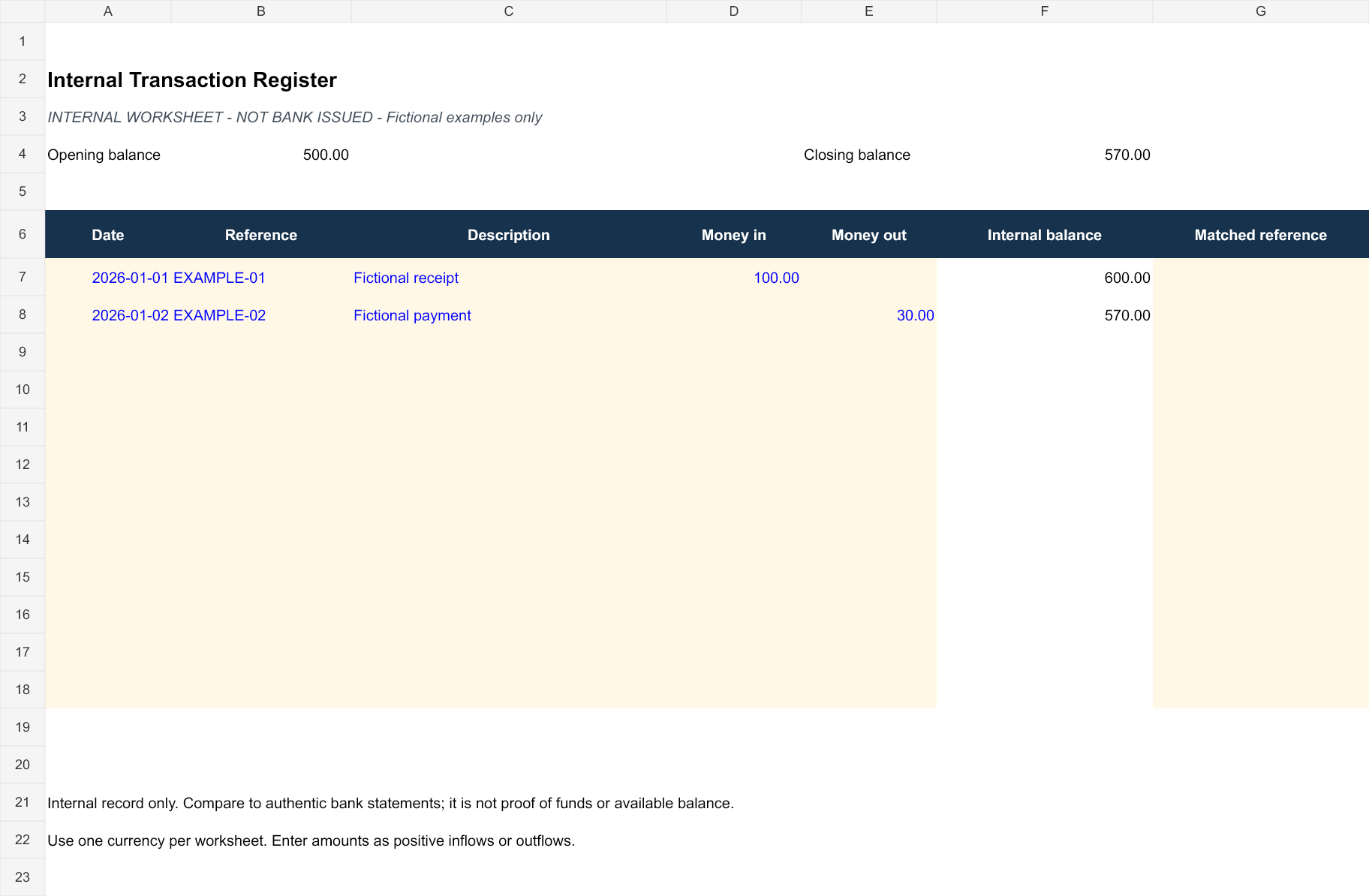
Download Internal Transaction Register (XLSX)
Bank Statement Comparison Worksheet
Compare a genuine bank statement balance to your book records and identified reconciling items.
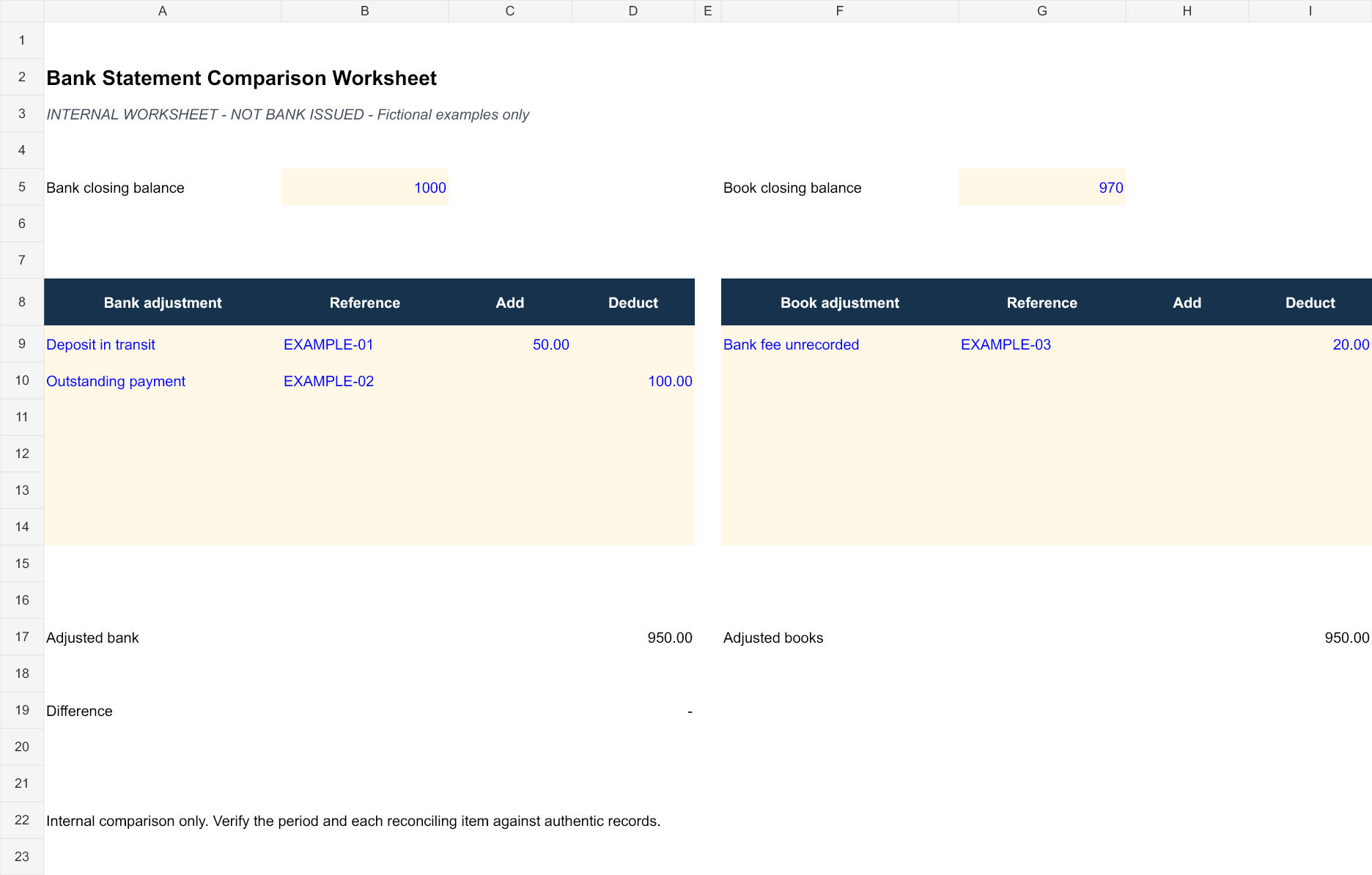
Download Bank Statement Comparison Worksheet (XLSX)
How to use the new downloads
The transaction register calculates from an entered opening balance and the twelve provided transaction rows. The comparison sheet has separate bank and book adjustments, with calculated adjusted balances and a difference. Both workbooks contain fictional examples and are prominently labeled as internal worksheets rather than bank-issued statements.
The comparison example starts with a bank closing figure of 1,000, adds a 50 deposit in transit, and deducts 100 in outstanding payments to reach 950. Books starting at 970 reach 950 after a 20 unrecorded bank fee. A zero difference supports the arithmetic of those entries; it does not authenticate the source documents or prove available funds.
What Is a Bank Statement?
A bank statement is a financial record that summarizes activity in a bank account over a specific period. It normally shows transactions such as deposits, withdrawals, transfers, payments, fees, and the resulting account balance.
A bank statement template can help users understand how this information can be organized into a structured document. Businesses may also use statement-style formats for internal accounting and recordkeeping, provided the document is clearly identified as an internal or sample record rather than an official bank-issued statement.
Free Bank Statement Template
A free bank statement template can save time when you need a structured format for demonstrating transaction information or preparing an internal financial record. You can customize headings, dates, transaction descriptions, amounts, and balances according to the legitimate purpose of the document.
A useful statement layout should make individual transactions easy to identify and distinguish between money coming into and leaving the account.
Bank Statement Format
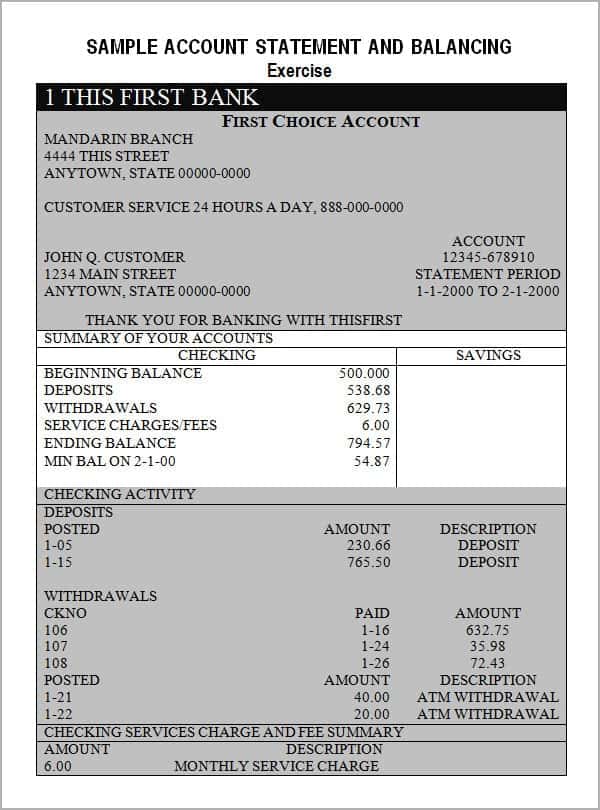
A typical bank statement format contains account-holder information followed by a transaction table. The table may include the transaction date, description, debit or withdrawal amount, credit or deposit amount, and running balance.
The format can vary considerably between financial institutions. Some statements also include account numbers or masked account identifiers, statement periods, opening and closing balances, fees, interest, and contact information.
When creating a sample or internal statement, avoid presenting it as an authentic document issued by a bank.
Personal and Business Bank Statement Templates
A personal bank statement template can be useful for educational exercises, budgeting demonstrations, or personal recordkeeping. A business bank statement template can similarly illustrate how business transactions and account activity can be organized.
Businesses that need official financial records should rely on statements and transaction reports supplied by their bank or accounting system. A template should not replace an official financial document.
Editable and Printable Bank Statement Template
An editable bank statement template can be modified to demonstrate different statement layouts or organize legitimate transaction information. You can adjust headings, transaction columns, statement periods, and other non-sensitive information to fit your intended use.
A printable bank statement template can be useful for educational materials, accounting exercises, financial-management demonstrations, or internal documentation. Before sharing a completed document, remove unnecessary sensitive financial information and clearly identify sample documents as such.
Using a structured statement format can make financial information easier to review, but official banking and financial verification should always rely on authentic records provided by the financial institution.
Label educational and internal documents clearly
Put Sample — fictional data or Internal transaction worksheet in a prominent location appropriate to the document’s purpose. Keep that description in exported and printed copies as well. A filename alone may be lost when someone prints a page or attaches it to another report.
Use invented names and clearly fictional references in a teaching exercise. Avoid copying a real person’s identity or full account number into a demonstration simply to make it appear realistic. A learner needs to understand the columns and arithmetic, rather than mistake the worksheet for evidence about a real account.
For an internal record using legitimate transaction information, identify who prepared it, the source used and the date of preparation. The worksheet should explain its relationship to the authentic record. It should not imply that the institution issued or endorsed the analysis.
A fictional opening-and-closing balance exercise
Assume an educational worksheet starts with 1,000 currency units. It then records an incoming amount of 250, an outgoing amount of 120 and a fee of 10. The closing figure for that simplified exercise is 1,120: 1,000 plus 250 minus 120 minus 10.
Show the lines separately and make the direction of each amount clear. If the exercise uses withdrawal and deposit columns, avoid also assigning a conflicting sign to the same amount. Define the convention at the start so learners can reproduce the result without guessing how the table should be read.
Those figures are fictional and do not demonstrate a real account balance or funds available to anyone. The exercise also does not include pending transactions, interest or other adjustments. If you add more entries, label them accurately and check the arithmetic without claiming that a template has verified the account.
Compare an authentic statement with your own record
For real bookkeeping, obtain the relevant statement from the bank through its supported process. Identify the period and account reference needed for the review. Keep the authentic document as the source and create any comparison notes separately.
An internal check register can organize transactions you expected to see. Compare dates, amounts and references with the bank’s recorded entries, marking which items have been matched. Differences may require explanation; do not assume that every unmatched item is necessarily a bank error.
A deposit preparation record can supply the expected contents and reference of a submitted deposit. The bank posting may need to be checked against that expectation. Keep preparation, submission and recorded posting distinct so the comparison does not treat an unsubmitted worksheet as a completed transaction.
Investigate differences without forcing agreement
If the totals differ, first check that you are comparing the same period, account and currency. Review transcription and whether items are pending or outside the statement period. Record the specific difference rather than entering an unexplained balancing amount to make the worksheet look complete.
Use supporting documents to clarify the event. A customer payment record or deposit confirmation can provide a reference, but it needs to be connected to the bank entry carefully. Similar amounts alone do not establish that two records refer to the same transaction.
A general journal worksheet serves another accounting role by organizing entries and supporting references. Any approved bookkeeping adjustment should follow the organization’s accounting process. Do not alter the authentic statement to represent an internal adjustment or an expected transaction that the bank has not recorded.
Ask the bank about unfamiliar or incorrect entries
Use the institution’s legitimate contact process when a transaction is unfamiliar or appears incorrect. Keep a clear note of the relevant entry, question and communication reference. Do not resolve the issue by deleting the line from a self-prepared statement-style document.
CFPB guidance for U.S. consumers explains that reporting unauthorized transactions promptly matters and that specific timing requirements can affect protections. Consult its guidance and the institution’s instructions for the situation. This article does not calculate a universal reporting deadline for every type of account or transaction.
Record the outcome using the bank’s response or subsequent authentic record as appropriate. A working note can explain what was questioned and how it was resolved. Keep an unresolved question visible instead of presenting a revised worksheet as though the institution has already confirmed a correction.
Keep transaction detail separate from budget categories
A statement description and a budget category are different pieces of information. An authentic transaction might have a merchant description, while your personal analysis assigns it to household supplies. Add that analysis in a separate field or worksheet rather than treating the category as the original bank description.
Do not assume every deposit is income or every withdrawal is an expense for accounting purposes. A transfer between a person’s own accounts, for example, has a different role from a payment for goods. The correct classification depends on the actual event and the accounting purpose.
An internal category can help analysis, but it should remain traceable to the original transaction reference. If you split a payment across categories, explain the basis and check that the allocated amounts reconcile to the transaction being analyzed. A useful analysis should remain understandable to its reviewer.
Share only the information needed for the purpose
Authentic statements can contain account identifiers, addresses and detailed transaction information. Determine what the recipient actually requires before sharing and use the requested secure submission route. Do not publish completed banking records in a public template gallery or an unrestricted shared folder.
For an educational exercise, use fictional data instead of trying to hide only selected details on a real statement. For another legitimate request, ask the recipient whether a permitted redacted copy is acceptable. Retain the original separately and do not conceal material information or present a changed record as an unmodified bank-issued document.
Check exported and printed versions of internal worksheets for unnecessary sensitive data. A label that is visible in the editing view should still be legible in the final copy. Access and retention should match the actual purpose and applicable recordkeeping arrangements.
Final checks for a legitimate working document
Confirm its title and sample or internal status, data source, period, amount conventions and calculations. Review any formulas in an Excel file before relying on them; an XLSX extension does not establish that totals have been programmed correctly.
Keep the document’s role clear when filing or sharing it. The templates illustrate layouts and support analysis. Official account evidence and bank corrections must come from the relevant institution’s process, while your worksheet records the exercise or analysis you prepared.
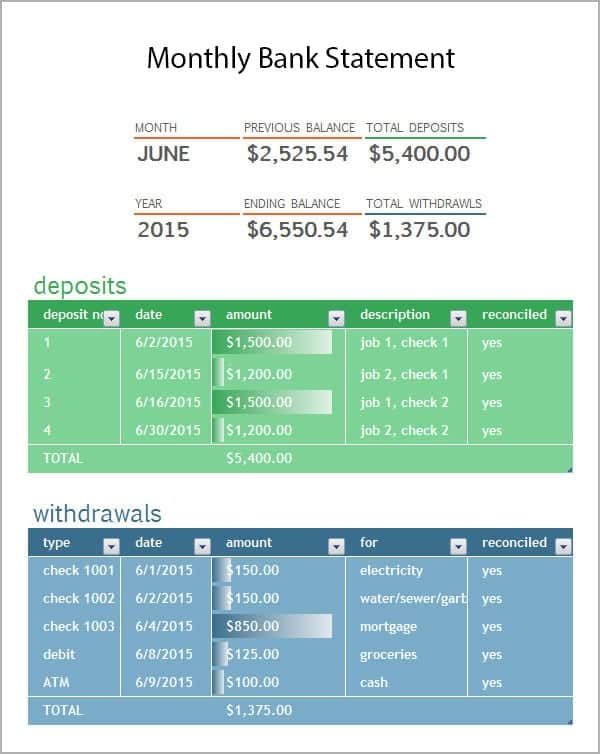
Download Bank Statement Templates Here
Download and See Bank statement templates:

Bank statement template FAQs
What formats are the two new downloads?
The two new downloads are Excel XLSX workbooks with formulas and fictional example inputs. Replace those examples, preserve the calculated cells and review your results. They are separate from the mixed resources in the original gallery.
Can a template replace the statement my bank issues?
No. Use authentic institution-issued records when banking evidence is required. A template can support a clearly labeled educational exercise or internal analysis, but it should not be presented as a bank-issued record.
What makes an educational balance exercise clear?
Use fictional information, label the document prominently as a sample and define how incoming and outgoing amounts are recorded. Show the opening balance, individual entries and closing calculation so a learner can reproduce the arithmetic.
Should I edit the bank statement when a transaction looks wrong?
Keep the authentic source unchanged and report the question through the bank’s supported process. Use a separate working note for the discrepancy and response. A self-edited document does not establish that the bank corrected its record.
Does an internal closing figure show money available to spend?
No. A worksheet calculation does not independently establish an account’s current status, pending activity or available funds. Obtain the relevant information through the institution’s actual account services and applicable transaction process.